All posts by Alan B. Zibluk

The Peter Promise Sin in our lives is not inevitable

Sin in our lives is not inevitable

Tags: Help, Holiness, Sin, Temptation
"If you do these things you will never fall" (2 Peter 1:10).

"He knew so much about the Bible; he had such a great ministry. How could this happen to him?"

People often have asked me such questions when a Christian leader has fallen because of money, sex, or pride.

The unasked question is left hanging in the air. "Since this happened to such a spiritual man (or woman), am I going to fall, too?"

I used to answer, "We’re all vulnerable. It could happen to anyone," echoing what other Christians have said in the past.

Some time ago I knew a middle-aged man in South America who was one of the most winsome evangelists that I have ever heard. But he had an attitude toward money that was unholy. He put away money that wasn’t his. Now he is no longer an evangelist. He is doing something else when he ought to be winning souls in the harvest field of Latin America.

As well, I was deeply grieved when I learned that a respected American youth evangelist with whom I had worked in the past had left his wife, his children, and his ministry for the passions of the flesh. It turned out that secretly, for years, he had been feeding a pornography addiction while preaching up a storm against immorality. Then, the inevitable happened. He started committing adultery. He had affairs going in city after city. Finally, the truth came out, and he walked out on his family.

When the truth came out, it shook me. It seemed to only prove the point: "We’re all susceptible to moral failure, right?"

I’m not so sure anymore. I now believe such thinking leads to fatalism, smacks of false humility, and flies in the face of Scripture.

Failure Is Not Inevitable
"We’re all vulnerable" isn’t true…if we’re staying in God’s Word, if we’re walking by the Spirit, if we’re obeying Jesus Christ. "If you do these things," 2 Peter 1:10 says, "you will never fall."

Peter isn’t using flowery language; he isn’t simply trying to make us feel better. These words are from the Bible; God Himself tells us, "If you do these things, you will never fall." What a wonderful promise!

Earlier in the same chapter, Peter tells us, "His divine power has given us everything we need for life and godliness through our knowledge of him who called us by his own glory and goodness" (2 Peter 1:3).

"All power" has been given to us through Jesus Christ, and His power is what enables us to live a godly life.

God doesn’t want us to shipwreck our faith, shatter our home, disgrace our church, or destroy the ministry He has entrusted to us. Instead, He has given us His indwelling presence and designed the Christian life so that we’ll succeed.

Walls of Protection
To keep us safe in His hand, God has established several strong walls of protection around us: the Word of God, including His moral laws; the Body of Christ, especially our local church; and His indwelling Holy Spirit, who is ever sensitive to sin in our lives.

But we can’t just sit around, hoping God will protect us when temptation comes our way. As John Wesley recognized during the Great Awakening, it is as Christians grow in grace and go on to maturity that they will be kept from falling.

"Paradoxically," Wesley biographer A. Skevington Wood reminds us, "to stand still is to be in danger of slipping back."

I encourage you to take action. First, don’t gossip and gloat when someone goes ahead and blatantly sins. We dare not secretly get a kick out of seeing someone else fail. Since temptations are common to us all, Scripture calls us to walk humbly in the fear of the Lord.

Second, make a radical decision to be holy as God is holy. Pray to God about your area of weakness. I did this early on in my ministry. I told God, point by point, how I behave in certain situations. I was embarrassed and recognized that God already knew how I acted, but it did me good to tell Him. Then I took Galatians 2:20 and reaffirmed with God my resolution to be crucified with Christ. I made a radical decision to be holy under every circumstance, without exception.

Third, begin a prayer group with one or more of your Christian friends. Let them know about your area of weakness–you don’t have to share in great detail. Ask them to hold you up in prayer before God as well as to hold you responsible for your actions. I meet each Wednesday with a group of respected, godly leaders in my city and have discovered great benefits.

Fourth, get back to reading the Bible. Several years ago when a rash of leaders were falling one after another, I asked my mentor, Dick Hillis, founder of one of the world’s leading missions organizations, "Why are all these guys falling away?"

Dr. Hillis thought and thought about my question. After walking with the Lord for sixty-some years, he’s no fly-by-night. Finally, he told me, "I think it’s because they were reading a lot of books about the Bible, but not the Bible itself."

The more I thought about it, the more I could see his point. Nothing can take the place of God’s Word, not even the best biblical commentaries. Sure, an evangelist or preacher or teacher needs to do his homework. He needs to read widely and deeply. But we need to saturate ourselves with God’s Word so, as the Psalmist wrote, "I might not sin against [God]" (Psalm 119:11).

As we read the Bible, associate with godly men and women, and follow the Holy Spirit’s leading, we are protected and kept safe in God’s hand.

Beware of Temptation
That’s not to say we won’t be tempted to climb over these divine walls of protection. For this reason we must beware of two seemingly innocent mistakes that make us vulnerable to Satan’s attacks: carelessness and opportunity.

Maybe we begin to hurry through our daily Bible reading or prayer time since we really don’t have much time. Perhaps we place ourselves in a tempting situation. Maybe we’re trying to serve God in our own power instead of in the power of the Spirit. It could be we’re feeling proud after gaining a victory over temptation. However it happens, carelessness creeps in and that’s when Satan strikes. The opportunity arises, and we fall into sin.

But we don’t have to go that route. The Bible promises, "God is faithful; he will not let you be tempted beyond what you can bear. But when you are tempted, he will also provide a way out so that you can stand up under it" (1 Corinthians 10:13). We are not helpless victims of Satan’s whims. He can defeat us only if we let him. Remember the Peter Principle: "If you do these things, you will never fall."

The Lord doesn’t want us to panic, to be fearful that we’ll be the next to fall. He "is able to keep you from falling and to present you before his glorious presence without fault and with great joy" (Jude 24).

Let’s not go around cringing, frightened we’re going to fall. We don’t need to be afraid of the world, scared that our sexuality or whatever is going to destroy us. If we are walking and growing in Christ, the Scripture says we will never fall–and that’s a promise!

Prayer
"Lord Jesus, I have the desire to do such-and-such, and I am settling the matter with you. By your power, I will not dishonor Your holy name. I’m going to live for Your glory. I am committed to live a pure life. Amen."

When faced with temptation, do you recognize the way of escape explained in 1 Corinthians 10:13? "No temptation has overtaken you except what is common to mankind. And God is faithful; he will not let you be tempted beyond what you can bear. But when you are tempted, he will also provide a way out so that you can endure it."

What is tempting you? Talk to another Christian today and learn how to fight temptation.

Alan Zibluk Markethive Founding Member

Time to regulate bitcoin says Treasury committee report

Time to regulate bitcoin, says Treasury committee report

Time to regulate bitcoin, says Treasury committee report


MPs in UK say ‘wild west’ cryptocurrency industry is leaving investors vulnerable


Bitcoin and other cryptocurrencies are “wild west” assets that expose investors to a litany of risks and are in urgent need of regulation, MPs on the Treasury select committee have said.


The committee said in a report that consumers were left unprotected from an unregulated industry that aided money laundering, while the government and regulators “bumble along” and fail to take action.


The Conservative MP Nicky Morgan, the chair of the committee, said the current situation was unsustainable.


“Bitcoin and other crypto-assets exist in the wild west industry of crypto-assets. This unregulated industry leaves investors facing numerous risks,” Morgan said. “Given the high price volatility, the hacking vulnerability of exchanges and the potential role in money laundering, the Treasury committee strongly believes that regulation should be introduced.”


Crypto-assets are not covered by the City regulator, the Financial Conduct Authority (FCA), and there are no formal mechanisms for consumer redress or investor compensation.


The committee argues in the report that at a minimum, regulation should be introduced to add consumer protection and counter money laundering.


It said that as things stood, the price of crypto-assets was so volatile that while potential gains were large, so too were potential losses. “Accordingly, investors should be prepared to lose all their money,” the committee said.


The FCA said: “The FCA agrees with the committee’s conclusion that bitcoin and similar crypto-assets are ill-suited to retail investors, and as we have warned in the past, investors in this type of crypto-asset should be prepared to lose all their money.”


A Treasury spokesman said: “We set up the joint Cryptoassets Taskforce earlier this year because we want to better understand the potential risks and benefits of crypto-assets to people, businesses, and the economy.”


In 2017, the price of a bitcoin soared by more than 900%, hitting a peak of almost $20,000 in December. Its popularity has since waned, with one bitcoin now priced at around $6,270.


Bitcoin: is it a bubble waiting to burst or a good investment?

Read more

The digital currency emerged after the financial crisis. It allows people to bypass banks and usual payment processes to pay for goods and services.


Last year Jamie Dimon, the chief executive of JP Morgan, said bitcoin was a fraud and only fit for use by drug dealers, murderers and people living in places such as North Korea. He said: “The currency isn’t going to work. You can’t have a business where people can invent a currency out of thin air and think that people who are buying it are really smart.”


Originally printed in the Guardian.

Alan Zibluk Markethive Founding Member

World’s Top 10 Youngest Billionaires

By Caitlin Kindig | Updated July 12, 2018 — 10:02 AM EDT

Thanks to family inheritances, family businesses, and technology startups, there seem to be more young billionaires today than at any point in history.  According to Forbes, the youngest billionaire in the world comes in at just 21 years old, with the tenth youngest being 32 years old. Kylie Jenner is on the cusp of being the world's youngest self-made billionaire, a title that Mark Zuckerberg, co-founder and chief executive officer (CEO) of Facebook (FB), earned in 2006 at the age of 23. Jenner, now 20 years old has an estimated net worth of $900 million and will turn 21 in August 2018.

This list is according to Forbes' real-time net worth ranking as of July 11, 2018.

1. Alexandra Andresen
Born in 1996, Alexandra Andresen is the world's youngest billionaire, at just 21 years old. She is a Norwegian heiress and the daughter of Johan H. Andresen Jr., who owns Ferd, a Norwegian investment company that runs hedge funds, actively invests in the Nordic Stock Exchange, and has private equity investments. In 2007, Andresen and her sister, Katharina, were each transferred 42.2% of the ownership stakes and subsequently inherited the money. Andresen has an estimated net worth of $1.4 billion. 

2. Katharina Andresen
Katharina Andresen is the world's second-youngest billionaire, as only her sister Alexandra is younger. Andresen also inherited 42.2% of the Ferd ownership stakes. She is 23 years old and has an estimated net worth of $1.4 billion. 

3. Gustav Magnar Witzoe
Gustav Magnar Witzoe owns nearly half of Salma ASA, one of the world's largest salmon producers. Salmar spearheaded the industrialization of salmon farming in Norway. This stake was given to him in 2013 by his father, Gustav Magar Sr., who founded the company in 1991. Because Witzoe Sr. still runs the company, Gustav invests in real estate and tech startups. He is 25 years old has an estimated net worth of $2.7 billion.

4. John Collison
John Collison is the owner and co-founder of Stripe, a company that builds software for businesses to plug into websites and apps to instantly connect with credit card and banking systems in order to receive payments. The 27-year-old Irish entrepreneur devised the idea for Stripe with his brother, Patrick, when they were both attending university in Boston. The company is valued at $9.2 billion, and Collison himself has an estimated net worth of $1 billion.

5. Evan Spiegel
Evan Spiegel is the co-founder and CEO of Snap Inc, a camera company which operates Snapchat — a photo messaging service that delivers temporary photos between friends. Snap Inc has a market cap of $16.7 billion as of July 11, 2018. Spiegel studied product design at Stanford University, where he met his co-founder and fellow billionaire, Bobby Murphy. Evan Spiegel is 28 years old and has a net worth of $3 billion.

6. Ludwig Theodor Braun
Ludwig Theodor Braun owns 10% of the medical device company B. Braun Melsungen, which was founded in 1839 as a small pharmacy that sold herbal remedies. Now, the company manufactures injection solutions and surgical instruments. The company had over $7.9 billion in sales for 2017. Braun is 28 years old and has an estimated net worth of $1.6 billion.

7. Bobby Murphy
Bobby Murphy is the second half of the co-founding pair that brought Snap Inc to the marketplace, and he also owns the company. Murphy is older than his fellow co-founder Spiegel and studied mathematics and computational science at Stanford University. Murphy is 29 years old and has an estimated net worth of $3 billion.

8. Patrick Collison
Brother of John Collison, Patrick is the co-founder and CEO of Stripe, the company that allows businesses and individuals to easily accept payment over the internet. Stripe's big-name investors include Elon Musk and Peter Thiel. Collison is 29 years old and has an estimated net worth of $1 billion.

9. Wang Han
Wang Han inherited wealth from the shares he holds in Juneyao Air, a major airline company based in Shanghai. He inherited the shares from his deceased father who founded Juneyao Group which also has business involvement in retailing, education, and food. Han is 30 years old and has an estimated net worth of $1.3 billion.

10. Lukas Walton
Lukas Walton is the grandson of the famous founder of Walmart Inc. (WMT), Sam Walton. He inherited his fortune as well as one-third of the family estate from his father, John Walton, who died in a plane crash in 2005. An active investor and philanthropist, Walton owns stakes in Walmart, First Solar, and Arvest Bank. He is 32 years old and has an estimated net worth of $14.2 billion.


Read more: World's Top 10 Youngest Billionaires | Investopedia https://www.investopedia.com/articles/personal-finance/101415/worlds-top-10-youngest-billionaires.asp#ixzz5RTXl2rsa 
Follow us: Investopedia on Facebook

Alan Zibluk Markethive Founding Member

Restored Sexuality- God’s plan for sex

God’s plan for sex

Written by Joy on 14/06/2016
Series: Weekly Devotional
Tags: Lust, Marriage, Sex, Sin
Carefully determine what pleases the Lord.

Ephesians 5:10
God created sex to be a beautiful gift. In Genesis 2, God says it was not good for man to be alone so God created the perfect partner, a woman, so they could become one flesh. The chapter closes with the statement, “they were both naked and felt no shame.” Sex creates a unique relationship that involves physical, emotional and mental unity and completion.

If sex is blessed by God, what makes it immoral?

Blessings Lost
When we forget God has authority to set limits, blessings are lost. “Yes, they knew God, but they wouldn’t worship him as God or even give him thanks. And they began to think up foolish ideas of what God was like. As a result, their minds became dark and confused.” (Romans 1:28). Your phone works best when you use it the way it was designed. In the same way, God designed sex to work a certain way. Rejecting His design leads to darkness, confusion, secrecy, shame, and judgement.

Blessed Design
God used His infinite wisdom to design sex in the beginning. God does not need to “evolve.” He does not change his mind based on our opinions. Scriptures from Genesis to Revelation give a very clear picture of the kind of sex that pleases God. “This explains why a man leaves his father and mother and bonds with his wife, and they become one flesh.” (Genesis 2:24). God approves of sex when it is between one man and one woman who have made a lifelong commitment to marriage. Jesus confirmed this to be an unchanging truth in Matthew 19.

Are you willing to trust God’s wisdom and love and follow his guidelines?

Blessing Restored
“He has rescued us from the domain of darkness and transferred us into the kingdom of the Son He loves. We have redemption, the forgiveness of sins, in Him.” (Colossians 1:13-14). We no longer have to sit in the darkness of shame and confusion. Jesus has made us children of light! (Ephesians 5:8-11)

“You cannot say that our bodies were made for sexual immorality. They were made for the Lord, and the Lord cares about our bodies…If we belong to Christ our body is not our own but a temple of the Holy Spirit and therefore we should honor God with our body.” (1 Corinthians 6:13, 19-20). Obedience to God’s plan for sex is a choice we make when we want to please God, not ourselves (Colossians 3:1-17). God has given every Christian the Holy Spirit to teach us truth and empower us to obey it.

Are you going to find out what pleases the Lord and choose to live by it?

Pray this week:
Show me, Lord, where I am not pleasing you in my attitudes and actions regarding sex.

Do you really know what Scriptures say about sexual sin? I

Alan Zibluk Markethive Founding Member
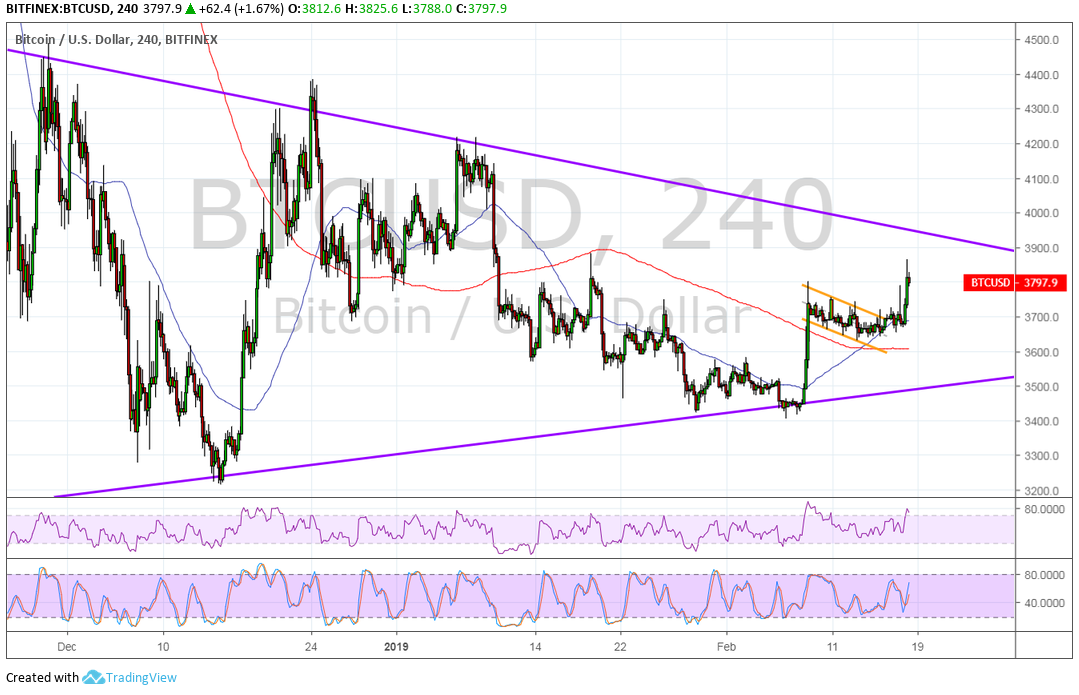
Bitcoin BTC Price Watch – Bearish Wedge Breakout

Bitcoin (BTC) Price Watch - Bearish Wedge Breakout

Bitcoin (BTC) Price Watch – Bearish Wedge Breakout

Bitcoin Price Key Highlights
 

  • Bitcoin price recently broke below a rising wedge pattern to signal that further losses are in the cards.

  • Price might still pull back to the broken support area, which lines up with Fib levels, to gather more selling pressure.

  • Technical indicators are showing that there is still some bullish momentum left.

Bitcoin price made a downside break from its rising wedge pattern but might be due for a pullback before heading further down.
 

Technical Indicators Signals


The 100 SMA is above the longer-term 200 SMA to indicate that the path of least resistance is still to the upside. In other words, there still might be a chance for the uptrend to resume.
 

However, the gap between the two is narrowing to reflect weaker bullish momentum and a possible downward crossover. Bitcoin price has also tumbled below both moving averages, so these might hold as dynamic resistance moving forward.
 

RSI is turning higher after recently dipping into oversold territory, suggesting a possible return in bullish pressure. Stochastic also looks ready to climb out of the oversold region and bitcoin price could follow suit once it heads north.
 

However, price could hit roadblocks at the Fib levels marked on the breakdown. The 61.8% Fib lines up with the broken wedge support around $6,430 and the 50% Fib lines up with the 200 SMA dynamic inflection point. If any of these levels keep gains in check, bitcoin price could resume the slide to the swing low or lower.

Risk aversion has returned to broader financial markets on account of the fresh set of tariffs imposed by the US on China. These tariffs, which are due to take effect on September 24, levy 10% of duties on $200 billion worth of Chinese goods and the rate would increase to 25% by the end of the year.


With that, it’s understandable that traders are dumping their riskier holdings and flocking back to the safe-havens. Cryptocurrencies have been deep in the red once more, with declines led by ethereum.

SARAH JENN | SEPTEMBER 18, 2018 | 3:52 AM

Alan Zibluk Markethive Founding Member

Avoiding Sexual Sin and Violation

Avoid taking advantage of someone else

Written by GodLife on 21/06/2016
Series: Weekly Devotional
Tags: Holiness, Love, Lust, Sanctification, Sex
Don’t violate or take advantage of a fellow believer in such matters. As we told you before and warned you: the Lord will settle the score with anyone who does these things.

1 Thessalonians 4:6
First Thessalonians 4:4-7 is about being sexually dishonest. Getting someone to sin with you is violating them, and God promises those who do these things will face consequences. Has someone taken advantage of you? Have you taken advantage of someone else? Here are some things God wants you to know about your responsibility to your sisters or brothers and how to avoid sexual sin and violation.

Flattery can be dangerous
Flattery means praise that is not honest. The person doing it always wants something in return. Is it OK to call another person ‘hot’ or ‘delicious’? It is not. These words describe food. Why use them for people? A person is not an object. Proverbs 6:26 describes how immorality makes objects of both of you: “…one is brought down to a loaf of bread.”?

Love makes you pure
To know what true love is, we can look at God Himself. (1 John 4:8, 16) First John 3:16 says: “We know what love is because Christ gave His life for us. We should give our lives for our brothers.” Christ gave Himself up for us. (Ephesians 5:25-27) His sacrifice made His Bride pure. That is what love is. Leading someone into impurity is not love. Using a weak person and making them do shameful things is the opposite of love.

Lust is the death of love
King David’s son Amnon thought he loved princess Tamar. He convinced David to send her to him while he pretended to be sick. “…he grabbed her and said, ‘Come to bed with me!’ ‘No,’ she said. ‘Don't force me to do such a degrading thing! That's awful! How could I ever hold up my head in public again? And you—you would be completely disgraced in Israel’ …he would not listen to her; and since he was stronger than she was, he overpowered her and raped her.” (2 Samuel 13:11-14) Afterward, Amnon hated Tamar and sent her away. This act later led to Amnon’s death and war in the nation of Israel.

Are you worried that a relationship has gone wrong? There is hope: God is not just the example but the source of love, and he can redeem it.Turn away from sin to trust Him. If you ask, He will send the Holy Spirit, who will bring His love into your life. “Hope never makes us ashamed because the love of God has come into our hearts through the Holy Spirit Who was given to us.” (Romans 5:5)

Pray this week:
For women worldwide who are being sexually assaulted every day.

Alan Zibluk Markethive Founding Member

PLAY BLACKJACK and POKER – FREE CASH GAME EVERY NIGHT and EARN BIG

TIME TO GET PAID???? !! Soooooo ….. Make sure to keep your eyes on our calendar this month! Two 24-hour free roll tournaments – one for poker and one for blackjack! Come on and get qualified so you can play for cash and prizes! There will be big winners???? Always free, Always fun! PLAY BLACKJACK and POKER FREE CASH GAME – TONIGHT! Registration starts at 10 PM EST and closes at 10:10 Sharp – Do not Be Late! Play free games and earn money FREE !! https://yiggiy.com/?Ref=RBM24-FE53P 

Yiggiy September PLAY! BlackJack and Poker -Come on and play… Get yourself registered and invite friends to come and play! Come win Cash and Big Prizes???? Yiggiy games are always FREE and always FUN????????

Come join the fun and share with your friends!???? 
Tonight is Yiggiy's $100 Blackjack Freeroll! 
Hit that like button, Get registered and Share…. 
See ya at the tables???? 
Yiggiy. Always Free, Always Fun! PLAY FOR FREE AT AND EARN REAL MONEY: https://yiggiy.com/?Ref=RBM24-FE53P

Get ready Yiggsters!????
On Sept. 25th & 29th we will unleash the Yiggiy beast! 
(Not really a beast, but that sounds good????)
FREEROLLS, nonstop for 24 hours! 
Blackjack on September 25th & Poker on the 29th!
Isn't that cool!!????  https://yiggiy.com/?Ref=RBM24-FE53P 

Alan Zibluk Markethive Founding Member

DOES THIS MARKET INDICATOR CONFIRM THE NOVOGRATZ PREDICTED REBOUND?

DOES THIS MARKET INDICATOR CONFIRM THE NOVOGRATZ PREDICTED REBOUND?

DOES THIS MARKET INDICATOR CONFIRM THE NOVOGRATZ PREDICTED REBOUND?

Bitcoin bull and highly cited cryptocurrency proponent Mike Novogratz called “bottom” this week on Twitter. On Friday, Bitcoin’s market performance and key market reversal indicated a possible turning point. What will Monday bring? Is the market still too bearish?


BITCOIN COULD HAVE OVERSOLD

According to a Friday report from Bloomberg, a key market sign — the Williams %R Indicator — is showing the market for Bitcoin (BTC) $6517.38 -0.04% has “oversold.”
 

This may portend that the great Bitcoin selloff is finally over. The Williams %R Indicator moves between a level of 0 and -100, showing an overbought or oversold market.
 

According to Bloomberg’s chart below, that measure is sitting at -83. This equates to an oversold market. The last time this level was reached Bitcoin price subsequently rose 22%, says Bloomberg.

NOVOGRATZ FORECASTS BOTTOM AND REBOUND TO EQUAL 2017 BOOM

On September 13, 2018, Mike Novogratz referred to the Bloomberg Galaxy Crypto Index Chart, asserted a low, and likened market performance to “the point of acceleration that led to the massive rally/bubble.” He finished his tweet with the hashtag #callingabottom.
 

PRE-WEEKEND RALLY… WHAT WILL MONDAY BRING?

On the day of Novogratz’ tweet, Bitcoin’s value began at $6337.46 before rising to $6589.32. Over the weekend the price has fallen back, but not too far —$6495.18at the time of writing. Monday and next week’s trading will likely prove or disprove Novogratz and Bloomberg’s theories.

As per Bitcoinist’s analysis today, we could be looking at a slow and steady recovery towards $7000 or it could be an “oversold” bounce. We predict Bitcoin is “well situated” for short-term gains, but could still be victim to a bearish market.

Novogratz isn’t the only confident bull. Tim Draper, speaking at a DealStreetAsia summit in Singapore last week predicted the total market capitalization for cryptocurrencies will reach a whopping $80 trillion by 2023. As of today, Bitcoin is still dominating the cryptocurrency markets, with 55% of the total market capitalization invested in Bitcoin alone.

Bullish or Bearish? Where are your sentiments today? What do you think next week will bring?


MELANIE KRAMER | SEP 17, 2018 | 00:00

Alan Zibluk Markethive Founding Member

Helping Those Who Question

Regard the curious as thirsty for living water.

Written by GodLife on 11/09/2018
Series: Weekly Devotional
Tags: Questions, Answers, Reasons, Evangelism, Apologetics
Honor Christ and let him be the Lord of your life. Always be ready to give an answer when someone asks you about your hope.

1 Peter 3:15
Have you ever asked a question, only to get another question as an answer? It’s not that uncommon, and it doesn’t mean the other person is avoiding your question. Here’s an example:

“So Philip ran to him and heard him reading Isaiah the prophet and asked, ‘Do you understand what you are reading?’ And he said, ‘How can I, unless someone guides me?’” (Acts 8:30-31)

People ask questions for all kinds of reasons. Sometimes they aren’t really asking for information—they either already think they know the answer or are raising a question as a cover for something. Here’s an example:

“But he, desiring to justify himself, said to Jesus, ‘And who is my neighbor?’” (Luke 10:25–29)

Jesus answered this question with one of the greatest parables in the Bible: the story we call the “Good Samaritan.” Even though the young man’s goal was to “justify himself,” Jesus worked creatively to reach him. 

It’s a good test of our walk with Jesus when we’re gracious with those who ask questions like he was. What are some ways we can do that?

Are all questions… even the not-so honest ones… opportunities?
The only way to avoid uncomfortable questions is to only associate with those who are certain they know all the answers. And this shows the value of questions. They imply the questioner is teachable. Both Peter (see 1 Peter 3:15, above) and Paul assumed believers would live lives that created opportunities to answer questions: “Walk in wisdom toward outsiders, making the best use of the time. Let your speech always be gracious, seasoned with salt, so that you may know how you ought to answer each person. (Colossians 4:5–6) 

Will they come whether you’re ready or not?
Jesus actually made it clear that people would question us–and that it’s a good thing, a way for God to be glorified.   “You are the light of the world. A city set on a hill cannot be hidden. Nor do people light a lamp and put it under a basket, but on a stand, and it gives light to all in the house. In the same way, let your light shine before others, so that they may see your good works and give glory to your Father who is in heaven.” (Matthew 5:14–16) A believer’s nature is meant to be an invitation for questions. We can’t be hidden, even if we try. God meant it to be like that as a way for His purposes to be worked out. (See Philippians 2:12-16)

How did Jesus use questions?
Did Jesus Himself get tough questions? You bet. Did He always answer them directly? No; in fact, He often answered questions with questions his critics couldn’t answer. “Then some of the scribes answered, ‘Teacher, you have spoken well.’ For they no longer dared to ask him any question.” (Luke 20:39-40). Very often, Jesus’ challenging questions were for the benefit of the surrounding listeners as well as the questioner. Every time I read these exchanges it makes me want to grow in my ability to answer and ask good questions.

Helping others who question, then, is Christ-like, isn’t it? It’s an opportunity to help the teachable, a way to fulfill God’s purposes for us, and a chance to embrace conformity to the image of Jesus. The next time you are questioned, how will you make it an opportunity to bring truth and love to the questioner?

Pray this week:
Lord Jesus, I want to be more like You. Show me where fear and pride make me defensive and keep me from helping others who question.

Alan Zibluk Markethive Founding Member

4 Bitcoin Bull Markets: Big Lessons to Learn

4 Bitcoin Bull Markets: Big Lessons to Learn

4 Bitcoin Bull Markets: Big Lessons to Learn

Wall Street’s so-called “experts” are creatures of habit. They behave in patterns that are as predictable as the tides.

When a market soars into bubble-land, they pour out of the woodwork to cheer the “powerful fundamental forces” that are driving prices higher.

When the bubble inevitably bursts, they scramble to predict its demise.

And precisely when a brand-new bull market is in the making, they pronounce its last rites.

Rarely is this pattern as clear as in cryptocurrencies, a much-maligned asset to begin with.

Just today, I found two strident Bitcoin eulogies. One refers to the “mother of all bubbles.” The other says that there’s no future in crypto.

Neither mentions that both the market and the market analysts are subject to the same cyclical pattern that repeats itself regularly:

Bitcoin enjoys a massive bull market, culminating in a frenzied parabolic surge of speculation — the period we call “the climax.”

It comes crashing down as speculators beat a panicky retreat.

It consolidates for months, creating a dead zone of sideways action or further decline, from which only the diehard survive.

And it launches a new bull market, repeating the cycle — again culminating in a blast-off climax.

But here’s the key:

In Cryptocurrencies, Each New Cycle Peak Is Dramatically Higher Than the Previous One.

The story begins in September 2010, just eight years ago, when Bitcoin was trading at close to 6 cents. Today, this same asset is trading at around $7,000 per token, a return of over 11 million percent.

No, the path from a half-dozen cents to thousands of dollars isn’t easy. Nor is it a straight line. But that’s the whole point: It happens in a cyclical pattern and that cycle is ultimately predictable.


Bull cycle #1. September 2010 to June 2011.

Bitcoin begins the cycle with a powerful but non-parabolic rise — from 6 cents to 80 cents by April 2011. Until this point, the rise is driven mostly by Bitcoin users and long-term investors who understand the technology and share the vision of its founder.

Then, suddenly, average investors begin to pile in. But the market is still minuscule, extremely illiquid and unable to accommodate crowds. So prices go ballistic: Bitcoin literally blasts off to the stratosphere, surging from 80 cents to a high of $36. (See blue-highlighted area of chart.)

The crash follows immediately thereafter, as Bitcoin plunges by 93%! Much like today, naysayers re-emerge — ranting about the “a failed experiment,” raving about “the death of Bitcoin.”

But it never trades below $2. So …

Even at the ultimate bottom of the crash, investors who bought at the beginning of the bull market cycle sit on gains of 38 times their original investment.


Bull cycle #2. October 2011 to April 2013.

Like in the prior bull cycle, Bitcoin enjoys a very solid run from its $2 low to about the $10 level, up fivefold.

Long-term buy-and-hold investors (nicknamed the “HODLers”), who bought early in the prior cycle, are delighted. But anyone who joined the prior cycle during the frantic run-up to $35 is still frustrated.

The frenzy returns in early January. The king of cryptos breaks out above $13 and starts accelerating to the upside once again, exploding to a nosebleed bubble high of $260 in April 2013.

Total rise from bottom to peak: about 13,000%! But again, the overwhelming bulk of the move is jammed into just two short months, from February 2013 to April 2013.

The bust strikes with even-greater fury. In less than a week, Bitcoin is back down to $50 by April 15 — an instant 80% crash!

And as usual, the “Bitcoin-is-dead” crowd dominates the headlines.

But as in the prior bull run …

Even at rock bottom, anyone who bought near the beginning of this cycle is sitting on an asset worth five times their original investment.


Bull cycle #3. April 2013 to December 2013.

As before, the recovery from the April low of $50 is initially slow, reaching the $100 level by Oct. 1, 2013.

And as before, it’s the last two months that deliver the giant price explosion — to $1,160 by December, a surge of 1,160%.

Irrational exuberance infects not only average investors, but also the media, which sings the praises of crypto … until, that is, the next bust strikes, ushering in Bitcoin’s longest bull market to date:

From its $1,160 high made in December 2013, Bitcoin plunges to a low of $150 by January 2015, an 87% decline.

The bear market is so long and so deep, Bitcoin evangelist Andreas Antonopoulos says he’s worried about the future of crypto.

But as before …

Even at the bottom, investors who bought at the beginning of the cycle still have tripled their original investment.

Moreover, this point is also the beginning of the greatest Bitcoin bull market of all time …


Bull cycle #4. January 2015 to December 2017.

It takes Bitcoin a couple of years to recover from its great bear market of 2014.


Then, the big action begins in 2017, as Bitcoin launches a solid move from roughly $1,000 in January to about $5,000 in October.
 

As in the three previous cycles, however, it’s not until the last two months of the bull run that the public jumps in with both feet. Prices rise like a rocket. Bitcoin surges to its high of nearly $20,000 by December.

And of course, the crash inevitably followed — taking Bitcoin down to $5,800 on Feb. 6, 2018, a 70% decline.

Many analysts, not personally familiar with the prior bull cycles, argue as if this is somehow “a new phenomenon.”

But as you’ve clearly seen, it’s anything but
 

It’s déjà vu. And for the third time!

The Next Bull Cycle is Still in the Making

If history is any guide …

• The first few months of the next bull cycle could be slow and choppy. Don’t expect prices to explode suddenly. But this will be the ideal time to invest.

• The core of the bull market will be solid but not parabolic. A good time to add steadily to your holdings.

• It’s not until the final blow-off phase that you will see Bitcoin make new all-time highs and rise parabolically. Time to take most of your money off the table in phases.

• The next crash is bound to wipe out at least half of the gains. But as before, early investors will still come out ahead. Even those who just HODL should be sitting on some fat profits.


3 Major Changes in the Bitcoin Bull Cycles

Some analysts may think the ups and downs in Bitcoin are just an endless merry-go-round. But the fact is, with each bull cycle, the cryptocurrency markets are also evolving and making progress toward a more mature phase, ushering in three major changes.
 

Change #1. Bitcoin is no longer alone.

With each cycle, especially the most recent one, a wide variety of new cryptocurrencies have been introduced — several with far more advanced technology and use-cases. We’ve seen the introduction of Ethereum and smart contracts … the emergence of Ripple, Stellar, NEO, EOS and Cardano … and soon, Hedera Hashgraph.
 

Change #2. Trading volume and liquidity have improved.

Consequently, the climactic phase (the last two months) of the bull cycle is becoming relatively less extreme.

• In the climax of the first bull cycle (ending June 2011), Bitcoin shot up 4,500%.

• In the climax of second bull market cycle (ending April 2013), the rise was 1,300%.

• In the climax of the third cycle (ending December 2013), prices increased 1,160%.

• And in the climax of the fourth cycle (through December 2017), Bitcoin surged by 400%.
 

Change #3. Adoption and infrastructure have steadily grown.

Before 2010, all trading was over the counter. In 2013, only one exchange existed. And in 2014, the biggest exchange, Mt. Gox, failed. But the consequence was the birth of dozens of new, more secure exchanges. And today, there are 206 operating exchanges, according to CoinMarketCap.com.

Stepping back from the trees, it’s clear that the best days of cryptocurrencies are yet to come.

From a fundamental standpoint, engagement in cryptocurrencies has never been greater. The infrastructure and underlying technology are in the best state that they’ve ever been. In the long term, there’s only one way to go from here: onward and upward.
 

By Juan M. Villaverde

September 16, 2018

Juan Villaverde is an econometrician and mathematician devoted to the analysis of cryptocurrencies since 2012. He leads the Weiss Ratings team of analysts and computer programmers who created Weiss cryptocurrency ratings.


Alan Zibluk Markethive Founding Member