4 Bitcoin Bull Markets: Big Lessons to Learn

4 Bitcoin Bull Markets: Big Lessons to Learn

4 Bitcoin Bull Markets: Big Lessons to Learn

Wall Street’s so-called “experts” are creatures of habit. They behave in patterns that are as predictable as the tides.

When a market soars into bubble-land, they pour out of the woodwork to cheer the “powerful fundamental forces” that are driving prices higher.

When the bubble inevitably bursts, they scramble to predict its demise.

And precisely when a brand-new bull market is in the making, they pronounce its last rites.

Rarely is this pattern as clear as in cryptocurrencies, a much-maligned asset to begin with.

Just today, I found two strident Bitcoin eulogies. One refers to the “mother of all bubbles.” The other says that there’s no future in crypto.

Neither mentions that both the market and the market analysts are subject to the same cyclical pattern that repeats itself regularly:

Bitcoin enjoys a massive bull market, culminating in a frenzied parabolic surge of speculation — the period we call “the climax.”

It comes crashing down as speculators beat a panicky retreat.

It consolidates for months, creating a dead zone of sideways action or further decline, from which only the diehard survive.

And it launches a new bull market, repeating the cycle — again culminating in a blast-off climax.

But here’s the key:

In Cryptocurrencies, Each New Cycle Peak Is Dramatically Higher Than the Previous One.

The story begins in September 2010, just eight years ago, when Bitcoin was trading at close to 6 cents. Today, this same asset is trading at around $7,000 per token, a return of over 11 million percent.

No, the path from a half-dozen cents to thousands of dollars isn’t easy. Nor is it a straight line. But that’s the whole point: It happens in a cyclical pattern and that cycle is ultimately predictable.


Bull cycle #1. September 2010 to June 2011.

Bitcoin begins the cycle with a powerful but non-parabolic rise — from 6 cents to 80 cents by April 2011. Until this point, the rise is driven mostly by Bitcoin users and long-term investors who understand the technology and share the vision of its founder.

Then, suddenly, average investors begin to pile in. But the market is still minuscule, extremely illiquid and unable to accommodate crowds. So prices go ballistic: Bitcoin literally blasts off to the stratosphere, surging from 80 cents to a high of $36. (See blue-highlighted area of chart.)

The crash follows immediately thereafter, as Bitcoin plunges by 93%! Much like today, naysayers re-emerge — ranting about the “a failed experiment,” raving about “the death of Bitcoin.”

But it never trades below $2. So …

Even at the ultimate bottom of the crash, investors who bought at the beginning of the bull market cycle sit on gains of 38 times their original investment.


Bull cycle #2. October 2011 to April 2013.

Like in the prior bull cycle, Bitcoin enjoys a very solid run from its $2 low to about the $10 level, up fivefold.

Long-term buy-and-hold investors (nicknamed the “HODLers”), who bought early in the prior cycle, are delighted. But anyone who joined the prior cycle during the frantic run-up to $35 is still frustrated.

The frenzy returns in early January. The king of cryptos breaks out above $13 and starts accelerating to the upside once again, exploding to a nosebleed bubble high of $260 in April 2013.

Total rise from bottom to peak: about 13,000%! But again, the overwhelming bulk of the move is jammed into just two short months, from February 2013 to April 2013.

The bust strikes with even-greater fury. In less than a week, Bitcoin is back down to $50 by April 15 — an instant 80% crash!

And as usual, the “Bitcoin-is-dead” crowd dominates the headlines.

But as in the prior bull run …

Even at rock bottom, anyone who bought near the beginning of this cycle is sitting on an asset worth five times their original investment.


Bull cycle #3. April 2013 to December 2013.

As before, the recovery from the April low of $50 is initially slow, reaching the $100 level by Oct. 1, 2013.

And as before, it’s the last two months that deliver the giant price explosion — to $1,160 by December, a surge of 1,160%.

Irrational exuberance infects not only average investors, but also the media, which sings the praises of crypto … until, that is, the next bust strikes, ushering in Bitcoin’s longest bull market to date:

From its $1,160 high made in December 2013, Bitcoin plunges to a low of $150 by January 2015, an 87% decline.

The bear market is so long and so deep, Bitcoin evangelist Andreas Antonopoulos says he’s worried about the future of crypto.

But as before …

Even at the bottom, investors who bought at the beginning of the cycle still have tripled their original investment.

Moreover, this point is also the beginning of the greatest Bitcoin bull market of all time …


Bull cycle #4. January 2015 to December 2017.

It takes Bitcoin a couple of years to recover from its great bear market of 2014.


Then, the big action begins in 2017, as Bitcoin launches a solid move from roughly $1,000 in January to about $5,000 in October.
 

As in the three previous cycles, however, it’s not until the last two months of the bull run that the public jumps in with both feet. Prices rise like a rocket. Bitcoin surges to its high of nearly $20,000 by December.

And of course, the crash inevitably followed — taking Bitcoin down to $5,800 on Feb. 6, 2018, a 70% decline.

Many analysts, not personally familiar with the prior bull cycles, argue as if this is somehow “a new phenomenon.”

But as you’ve clearly seen, it’s anything but
 

It’s déjà vu. And for the third time!

The Next Bull Cycle is Still in the Making

If history is any guide …

• The first few months of the next bull cycle could be slow and choppy. Don’t expect prices to explode suddenly. But this will be the ideal time to invest.

• The core of the bull market will be solid but not parabolic. A good time to add steadily to your holdings.

• It’s not until the final blow-off phase that you will see Bitcoin make new all-time highs and rise parabolically. Time to take most of your money off the table in phases.

• The next crash is bound to wipe out at least half of the gains. But as before, early investors will still come out ahead. Even those who just HODL should be sitting on some fat profits.


3 Major Changes in the Bitcoin Bull Cycles

Some analysts may think the ups and downs in Bitcoin are just an endless merry-go-round. But the fact is, with each bull cycle, the cryptocurrency markets are also evolving and making progress toward a more mature phase, ushering in three major changes.
 

Change #1. Bitcoin is no longer alone.

With each cycle, especially the most recent one, a wide variety of new cryptocurrencies have been introduced — several with far more advanced technology and use-cases. We’ve seen the introduction of Ethereum and smart contracts … the emergence of Ripple, Stellar, NEO, EOS and Cardano … and soon, Hedera Hashgraph.
 

Change #2. Trading volume and liquidity have improved.

Consequently, the climactic phase (the last two months) of the bull cycle is becoming relatively less extreme.

• In the climax of the first bull cycle (ending June 2011), Bitcoin shot up 4,500%.

• In the climax of second bull market cycle (ending April 2013), the rise was 1,300%.

• In the climax of the third cycle (ending December 2013), prices increased 1,160%.

• And in the climax of the fourth cycle (through December 2017), Bitcoin surged by 400%.
 

Change #3. Adoption and infrastructure have steadily grown.

Before 2010, all trading was over the counter. In 2013, only one exchange existed. And in 2014, the biggest exchange, Mt. Gox, failed. But the consequence was the birth of dozens of new, more secure exchanges. And today, there are 206 operating exchanges, according to CoinMarketCap.com.

Stepping back from the trees, it’s clear that the best days of cryptocurrencies are yet to come.

From a fundamental standpoint, engagement in cryptocurrencies has never been greater. The infrastructure and underlying technology are in the best state that they’ve ever been. In the long term, there’s only one way to go from here: onward and upward.
 

By Juan M. Villaverde

September 16, 2018

Juan Villaverde is an econometrician and mathematician devoted to the analysis of cryptocurrencies since 2012. He leads the Weiss Ratings team of analysts and computer programmers who created Weiss cryptocurrency ratings.


Alan Zibluk Markethive Founding Member

Bitcoin will reach 8500 by end of year says Trefis predicts ETF approval will cause bull run

Bitcoin will reach $8500 by end of year, says Trefis; predicts ETF approval will cause bull run

Bitcoin will reach $8500 by end of year, says Trefis; predicts ETF approval will cause bull run

Trefis Team, a firm offering software that predicts market movements, recently offered their opinion on the price of Bitcoin [BTC]. While the cryptocurrency market has been seeing bullish news lately, the price continues to exhibit sluggish movement.

Bitcoin, the top cryptocurrency, is currently trading at the $6500 mark after a series of sharp drops last week. Goldman Sachs stated that they would delay the plans of its cryptocurrency trading desk, leading to a widespread selloff due to FUD.

However, Trefis claims to have predicted the price of Bitcoin by the end of 2018, putting it around $8500 around the timeframe. Their predictions are based on the overall transaction volume for Bitcoin and the total number of users on the blockchain. Moreover, their predictions, when backtested, are reportedly 94% accurate as stated on their website.

They utilize the principles of supply and demand to fundamentally determine the price of Bitcoin. The cryptocurrency, with its capped supply and deflationary system of bringing new coins into existence, has a supply system that would help the case of its price rising. The two variables that Trefis has considered to calculate the demand is the number of active users and the amount they transact.

According to these calculations, they expect the price of Bitcoin to undergo a 30% increase over the year, quoting reasons such as the general sentiment dictated by the news. This, according to them, was the reason for the price to go up to $20,000 late last year. They also stated that the price has moved in tandem with news, with dips being observed when exchanges were hacked and when the United States Securities and Exchanges Commission [SEC] denied applications for an exchange-traded fund [ETF].

According to Trefis, the creation and general lobbying of the Blockchain Association will also create a more positive view for regulators. They stated that the approval of the ETF by the SEC is one of the biggest catalysts for the growth of Bitcoin. It represents a “huge potential upside” to the price of Bitcoin.

Iarius Germund, a market analyst, stated:

“While the market still responds sluggishly to a lot of the news coming out right now, the base is gradually being built. At the same time last year, the cryptocurrency market did not have many of the things it required for mainstream adoption as an asset class. We have made considerable progress on that end, but the price is only likely to move when actual changes occur in the market with respect to adoption.”


Anirudh VK

Published 29 mins ago on September 15, 2018

Alan Zibluk Markethive Founding Member
Many investors wonder why NagriCoin requires completing KYC procedure

All about KYC

Many investors wonder why NagriCoin requires completing KYC procedure and how to do that. With verifying process implementation, our investors and airdrop/bounty participants ask about similar issues. Today, NagriCoin team will answer the most popular questions about our KYC.

What is KYC? KYC or Know Your Customer is a process of verifying customer’s/client’s/investor’s identity. It reduces the risk of illegal manipulations inside NagriCoin ecosystem and protects our investors.
Why do I have to go through the KYC process? There are new laws being introduced globally on cryptocurrency transactions that make this a necessary step.
Do the participants of the bounty campaign and airdrop should pass KYC? Yes. We ask every token holder to pass KYC, including airdrop and bounty participants.
Why did you add KYC for everyone? Today, KYC for all token holders is a basic requirement of all top exchanges. We respect our customers and want them to have an opportunity to buy/sell tokens at the best exchanges. It has even more advantages for our bounty participants and the airdrop token holders: with the help of KYC, we ensure we issue your tokens appropriately.
Do I need to pass KYC before getting bounty/airdrop tokens? Why? Yes, you need to pass KYC before getting bounty/airdrop tokens. As we said earlier, all centralized exchanges require this process no matter if the tokens were airdropped or purchased. Also, we do that to protect you and ensure no violation of the bounty program are done. This is a process everyone has to pass including team members.
How to pass the KYC procedure? NagriCoin started supporting Telegram passport. Therefore, to pass our KYC, you just need to upload your documents and share your information with us. If you want to pass KYC without telegram passport, use Authenteq https://authenteq.com/. You should download its app for Android and iOS . Pass verification process using selfie and document scanning in the app. After receiving confirmation, scan QR-code on the left side of the screen. If everything is done right, you will get one more confirmation.
BlockchainKycTelegram
Like what you read? Give Nagricoin a round of applause.
From a quick cheer to a standing ovation, clap to show how much you enjoyed this story.

Nagri-HL is the future of modern agriculture, because this fertilizer is 100% organic and non-harmful for plants and animals. Revolution of the agricultural sector have only started and NagriCoin would play a significant part in it! Good time to invest your money on. More investment more profit. Don't lose your chance!
https://nagricoin.io/#sect_token

Alan Zibluk Markethive Founding Member
BitPay Executive Maintains Bullish Stance on Bitcoin

BitPay Executive Maintains Bullish Stance on Bitcoin

BitPay Executive Maintains Bullish Stance on Bitcoin
 

Amid a multi-month downtrend, the price of altcoins and Bitcoin have fallen to yearly lows, pushing market sentiment to near bottom. While price action wanes, BitPay’s Chief Commercial Officer Sonny Singh maintains an optimistic outlook on Bitcoin.

Bitcoin Gaining Institutional Traction

Following the drastic Bitcoin price drop last week, Singh appeared on Bloomberg to discuss the state of the cryptocurrency market and the future of the industry.

Founded in 2011, BitPay offers Bitcoin and Bitcoin Cash payments processing and storage services for merchants around the world.

With institutional solutions to cryptocurrency investing on the rise, Singh believes the market is too eager for certain catalysts to arrive:

“Right now, you’re just seeing rumors that somebody might do something–someone might launch a trading desk; someone might not be launching a trading desk. But I think next year, you’re going to see the big entrance become real; where you see Goldman does launch a trading desk; fidelity does launch a Bitcoin product; Square offers Bitcoin processing for merchants; Blackrock launches an ETF. So all that will then become real and you’ll see some adoption, actually, and you’ll see the price start bouncing back up again.”

Wall Street firms continue to explore digital asset investment products and services, but few have confirmed their plans to follow through. Currently, there are no major investment banks that offer direct cryptocurrency trading services to clients.

Earlier this month, Goldman Sachs CFO Martin Chavez confirmed that the firm never had a defined timeline to launch a Bitcoin trading desk, which had been largely anticipated earlier in the summer.

On Aug. 22, the U.S. Securities and Exchange Commission (SEC) rejected nine Bitcoin ETF applications by ProShares, Direxion and GraniteShares.

The SEC cited failure to prevent manipulation and fraud as well as failure to prove Bitcoin markets are “markets of significant size” as reasons for rejection. This was similar to the reasoning provided by the SEC when it issued a denial of the Winklevoss ETF.

While investment products may still be farther off on the horizon, it’s apparent that the development of blockchain technologies and adoption is still growing. With increasing Bitcoin payments volume on BitPay, Singh gave a bullish stance on the largest cryptocurrency’s future growth:

“Bitcoin will rebound next year when all these products become mainstream adopted. And we’re seeing no slow down at all at BitPay. Our merchants are seeing great growth still every week. They’re signing up more and more all the time. We’re hiring more salespeople.”

Maintaining an optimistic outlook on Bitcoin, Singh did not share the same sentiment for the falling altcoin market, stating:

“It’s still full speed ahead in the Bitcoin space. I can’t guarantee what’s going to happen in the altcoin world. There’s a lot of dodgy ones that are out there that are still overvalued. They can go a lot further down. Who knows what’s going to happen to them. But Bitcoin, again, is the leader in this space.”

The overall cryptocurrency market continues to show a general downward trend. While institutional solutions and emerging regulations continue to develop, it’s unclear which way the market will move.

Traders are reminded to remain cautious and invest only what they can afford to lose.


Jonathan Kim

Alan Zibluk Markethive Founding Member
Jesus said I will build My Church and the gates of Hades will not overpower it

How Does it Work?
Jesus said, "I will build My Church, and the gates of Hades will not overpower it" (Matthew 16:18). But how is Jesus building His Church?

Series: New Believers Guide

So how does the Church work? Jesus said, "I will build My Church, and the gates of Hades will not overpower it" (Matthew 16:18). But how is Jesus building His Church? Ephesians 4:16 tells us the answer: "As each part does its own special work, it helps the other parts grow." Did you know that you are meant to play a crucial part in God’s family?

"They were continually devoting themselves to the apostles’ teaching and to fellowship, to the breaking of bread and to prayer." Acts 2:42

Don't Miss Out!
Imagine for a moment a young boy who never wanted anything to do with his family. He never came out for family dinner, but just ran in his room when he got home from school. He never did any chores around the house, refused to clean his room, and pushed his brother whenever he saw him. In addition, this boy had it in him to become a great soccer player, but he never let his dad teach him how to play. Think of all that child would miss out on! Not to mention how the family would suffer as well.

"Day by day continuing with one mind in the temple, and breaking bread from house to house, they were taking their meals together with gladness and sincerity of heart." Acts 2:46

Just Like a Family, the Church has a Give-and-Take Relationship
— like how people need the oxygen trees give off and trees need the carbon dioxide people breathe out. Just the same, you need the Church, and the church also needs you. Look at mutual benefits of being in a church:

You are Protected
Just as a house keeps people protected from harm, so God's house keeps Christians safe from false teaching. God gave this instruction to pastors: "So guard yourselves and God's people. Feed and shepherd God's flock — his church, purchased with his own blood — over which the Holy Spirit has appointed you as elders" (Acts 20:28).

You are Taught How to Follow Jesus
1 Peter 2:2-3 says, "Like newborn babies, you must crave pure spiritual milk so that you will grow into a full experience of salvation. Cry out for this nourishment, now that you have had a taste of the Lord’s kindness." Newborns can’t feed themselves; they need someone to help them. Pastors and teachers help you grow as a Christian as they feed you the spiritual food of the Bible and help you know God better.

You Learn How to Love Your Family
Jesus said, "So now I am giving you a new commandment: Love each other. Just as I have loved you, you should love each other. Your love for one another will prove to the world that you are my disciples" (John 13:34-35). Being part of a church family helps you learn how to love others and their differences and show the love of Jesus to the world.

You Discover and Use Your Gifts
Have you ever had someone tell you that you are good at something you were unaware of? God has given you spiritual gifts, and your church family can help you discover them and learn how to use them. The Bible says, "Since you want spiritual gifts very much, seek most of all to have the gifts that help the church grow stronger" (1 Corinthians 14:12). As you use your gifts, the church is strengthened and grows.

You Need the Church and the Church Needs You
What are the gifts God has given you to build His Church? Maybe you haven't discovered them yet. As you join a spiritual family, you grow as a Christian and help the whole body of Christ to grow as well.

"Therefore encourage one another and build up one another, just as you also are doing." 1 Thessalonians 5:11


Watch the video  :   https://youtu.be/pM6Y9VZKmK4

Alan Zibluk Markethive Founding Member

Cryptocurrencies Pick Up – Bitcoin Emerges As Safe Haven

Cryptocurrencies Pick Up -  Bitcoin Emerges As Safe Haven

Cryptocurrencies Pick Up – Bitcoin Emerges As Safe Haven

Investing.com – Bitcoin and other major cryptocurrencies steadied on Thursday morning in Asia after days of plummeting.

Bitcoin rose 2.08% to $6,394.7 at 10:30AM ET (02:30 GMT) on the Bitifinex exchange.

Ethereum climbed 4.29% to $188.72 on the Bitifinex exchange.

XRP/USD also edged up 4.9% to $0.27088 on the Poloniex exchange, while Litecoin rose 3.83% to $52.866 on the Bitifinex exchange.
 

Despite the volatility of recent weeks, Bitcoin’s value has risen 0.1% over the past 30 days, making it something of a safe haven among digital currencies. Ethereum, on the other hand, has slumped about 45% over the past 30 days.

“In this case, Bitcoin is acting like more of a safe haven for cryptocurrencies – it’s kind of consolidating,” said Mati Greenspan, senior market analyst at cryptocurrency brokerage eToro.


Market Intelligence platform CoinFi’s data revealed that short-sellers are putting pressure on markets as bets against Ethereum is at all-time high.

“Retail investors were completely euphoric a few months ago. Now, that emotion has flipped and they’re panicking. Shorts are going to ride that wave,” said CoinFi CEO Timothy Tam.
 

Chinese Wuhan General Group (China) Inc. is seeking to acquire a former U.S. Department of Defense data center to transform it into a digital currency mine and house 1,200 mining machines there.

“We had planned to build this operation three months ago, but with the bearish cryptocurrency market, we took a step back to reassess our strategy,” said Wuhan Group’s CEO Ramy Kamaneh.


On Tuesday, U.S. securities regulator announced tighter measures on companies involved with cryptocurrencies.
 

On Monday, Mexico also took steps to required crypto exchanges and banks offering crypto services in the country to obtain a permit from the Bank of Mexico. Users will also not be allowed to access cryptocurrencies on the same day their accounts are created, under new rules.


Assets acquired by crypto beneficiaries need to undergo additional validation checks to prevent money laundering and illicit activities.


Alan Zibluk Markethive Founding Member
Bitcoin rises above 6300 as NY approves dollar-linked digital currencies

Bitcoin rises above $6,300 as NY approves dollar-linked digital currencies

Bitcoin rises above $6,300 as NY approves dollar-linked digital currencies

Bitcoin briefly climbed above $6,300 on Monday after New York state’s Department of Financial Services approved the Gemini Trust Company’s and Paxos Trust Company’s dollar-linked digital currencies, the first stable coins to get the nod from the regulator.

At 9:24am (1324 GMT), the world’s biggest and best known virtual currency was up 0.58% at $6,268.50 on the Luxembourg-based Bitstamp exchange.

Alan Zibluk Markethive Founding Member
Do You Have to Go to Church?

Let’s find out the true meaning of church.

Written by Joy on 30/11/2014
Series: Weekly Devotional
Tags: Church And Community
“Do not give up meeting together as some people do, but encourage one another, especially now that the day of his return is drawing near.” Hebrews 10:25

There are church services on television and the Internet. But is it ok to stay at home and watch a church service? Or do we have to go to a physical church building? Let’s find out the true meaning of church.

Church: The Body of Christ
When God talks about the church, he isn’t talking about a physical building. The church is all the people in the world who have put their faith in Jesus, sometimes called the body of Christ.

Christians are instructed to meet together regularly. (Hebrews 10:25) Many Christians go to church buildings (local churches). But if there isn’t a local church near you, don’t worry. You can meet in a house church, a secret meeting place or a public place where you can fellowship. The important thing is to meet with other Christians so you can learn, fellowship, and work together to teach others about God.

Divide and Conquer: Enemy Strategy
It’s not easy to overpower a group of people because there’s strength in numbers. But if you divide them, you can easily conquer. The Bible even talks about the benefits of being with another person instead of being alone. “Two are better off than one, for they can help each other succeed. If one person falls, the other can reach out and help. But someone who falls alone is in real trouble.” (Ecclesiastes 4:9-10)

As Christians, we have an enemy who wants to divide us. “Stay alert! Watch out for your great enemy, the devil. He prowls around like a roaring lion, looking for someone to devour.” (I Peter 5:8). Satan tries to separate you from other believers because he knows you are weaker when you are alone. When we are in a group, we can support each other, hold each other accountable and pray for each other. Satan will not be able to drag one of us off into the wilderness of unbelief, doubt, or despair.

United in Love: Jesus’ Prayer
Jesus prayed for us to be united. (John 17:9-11). He told us to “Love one another” (John 13:34) and “Encourage one another” (I Thessalonians 5:11). You’ll be able to do all of that and more when you’re united with other believers by meeting together. If you haven’t put your faith in Jesus yet, become a part of the body of Christ today and you can begin meeting with other believers too!

Pray this week:
That God will direct you to a local church where you can belong and how you can be an encouragement to other believers.

Alan Zibluk Markethive Founding Member

Bitcoin BTC Price Watch – Tight Battle Between Bulls and Bears

Bitcoin (BTC) Price Watch - Tight Battle Between Bulls and Bears

Bitcoin (BTC) Price Watch – Tight Battle Between Bulls and Bears


Bitcoin Price Key Highlights

  • Bitcoin price is currently consolidating in a short-term symmetrical triangle visible on the 1-hour chart.

  • The breakout could set the longer-term direction for bitcoin as it nears a key support area.

  • Technical indicators are suggesting that a downside move is more likely to happen than an upside break.

Bitcoin is consolidating inside a symmetrical triangle, which might be a bearish continuation pattern from the earlier drop.


Technical Indicators Signals

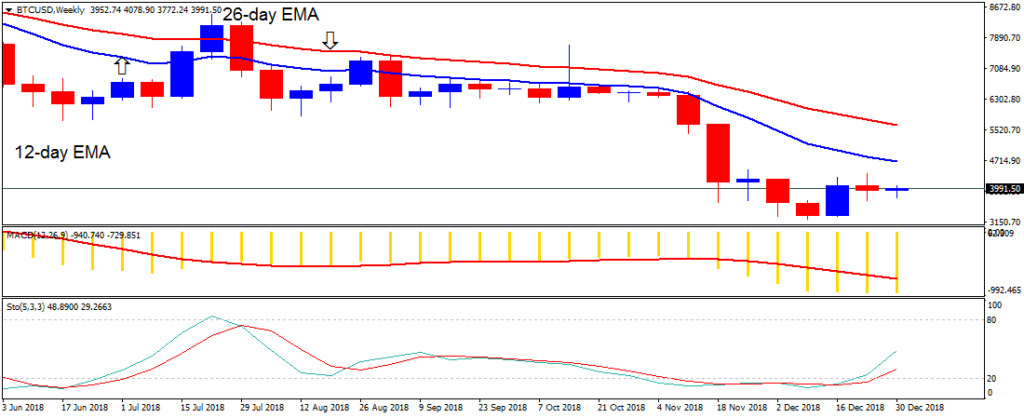
The 100 SMA is below the longer-term 200 SMA to indicate that the path of least resistance is to the downside. In other words, the selloff is more likely to resume than to reverse. The 100 SMA also lines up with the top of the triangle to add to its strength as resistance also.

The gap between the moving averages has been widening to reflect stronger bearish pressure. A break below the $6,250 level could be enough to signal a bearish break and further losses, possibly by the same height as the mast of the flag that spans $7,400 to around $6,200.

RSI is already turning lower after spending a brief period in overbought levels, indicating that bears are eager to return. Stochastic is also pointing back down and may draw more selling pressure.

Market Factors

Bitcoin was off to a terrible start for the week on reports that the SEC decided to suspend trading in a couple of crypto-based securities. This weighed on odds that the regulator could approve the bitcoin ETF applications anytime soon as they could site similar reasons on their ruling.

However, it’s worth noting that there were some positive updates so far this week, including the NYDFS backing of the Winklevoss twins’ fiat-based stablecoin. There have also been developments in Canada as a bitcoin fund achieved mutual fund trust status, allowing unit holders to put units in a self-directed registered account such as an RRSP or TFSA.


SARAH JENN | SEPTEMBER 11, 2018 | 4:54 AM

Alan Zibluk Markethive Founding Member

Is Online Church Enough?

Online church services are a great resource — make sure they don’t become your only community

Written by GodLife on 04/09/2018
Series: Weekly Devotional
Tags: Church, Church And Community, Fellowship, Online Church
And let us consider how to stir up one another to love and good works, not neglecting to meet together, as is the habit of some, but encouraging one another, and all the more as you see the Day drawing near.

Hebrews 10:24-25
Balancing Online and Physical Church 
My husband and I found a great church. This place has excellent, Bible-based teaching, opportunities to serve, with a young, growing membership. The church offers multiple service times and great music. Unfortunately, we ended up moving. “No problem”, we both thought. “We can just go online and watch the services. At least that way we can still get great teaching while we look for a church in our new town.” 

Here’s what we discovered. Finding a church can be hard! Especially when the one you attended before was so great. Some weeks it was easy to say, “let’s just watch online today.” That counts, right? 
No matter where you live, you have to decide what to do about church and community, both online and in-person. The reality today is the online church community has so much to offer and may feel like an easier place to fit in. Many people are a part of multiple communities, online and offline. How do you balance them? Can one substitute for the other? 

The purpose of going to church
Notice I didn’t say “the purpose of church” because ‘church’ is not a physical place. the church is made up of people who follow Jesus. As Christians, we work together as “the church” to share the love of Jesus with others. Acts 2:42 provides some of the reasons for church. “And they devoted themselves to the apostles' teaching and the fellowship, to the breaking of bread and the prayers.” 

You can do many of the same things online and offline. You can share Jesus’ love, learn about Jesus, and read the Bible. With so many sermons and studies online, it is easy to find just about any material you need to help you grow spiritually. Online church allows you to build community fellowship globally and expand your perspective, while your local church may be limiting your connections to people who are just like you. So why go to a physical church rather than bonding and worshipping only in an online community? Physical touch, serving and gathering are just three reasons.

Physical touch
Britain recently appointed its first ‘minister for loneliness’ acknowledging how isolated many people have become. Part of that isolation is not simply mental loneliness but a lack of connection physically, too. I remember my mom saying several years after my father died that one of the hardest things she faced was not having daily physical contact with anyone – hugging, a touch on the hand, and just close proximity to another person in the room. There were those around Jesus who needed to hear His message in this way because there are people who are best wired to receive communication about love by physical touch. "And behold, a leper came to him and knelt before him, saying, 'Lord, if you will, you can make me clean.' And Jesus stretched out his hand and touched him, saying, 'I will; be clean.' And immediately his leprosy was cleansed." (Matthew 8:2–3)

Going to church is a way to physically connect to followers of Jesus and remind ourselves that we are not just mental or spiritual beings but we exist together and have a common purpose. 

Serving in your community
Sure, you can give money through your phone to help others – even those in your neighborhood. The community church makes it more personal. As the church opens its doors in times of disaster or through helping local families with specific needs, Jesus can shine through your face when you participate in service. James 1:27 tells us: “Religion that is pure and undefiled before God, the Father, is this: to visit orphans and widows in their affliction, and to keep oneself unstained from the world.” 

Gathering
We are here to gather with other believers in Christian fellowship, and a smartphone can never completely replace that. The term “church” in Greek (ekklesia) means a called assembly. In ancient times when a city called its people together for a certain purpose, this was always called an ekklesia. My husband and I once had a “Skype dinner” with some friends who had moved away. We just wanted to see their faces and eat together like we did when they lived near us. While it was fun, it wasn’t the same as being together. 

Balancing your online church practices with your physical ones can be a challenge. Both have so much to offer, it can be tempting to replace one for the other. How you use those resources God provided in a balanced way is a decision you have to make. “Look carefully then how you walk, not as unwise but as wise.” (Ephesians 5:15)

Pray this week:
Father, show me how to serve you. Lead me to more fully be a part of the church in all areas, through worship, teaching, giving, fellowship and prayer.

Do you struggle with balancing your life online and offline? Do you view your community church differently than online church?

Alan Zibluk Markethive Founding Member

Look Mom I have a Blog