Tag Archives: crypto

Exploring Markethive’s KEY Validation Protocol and its Unique Reward Framework

Exploring Markethive's KEY Validation Protocol and its Unique Reward Framework

Within the Markethive ecosystem, completing the Know Your Customer (KYC) process is essential for members to access various platform features and benefits. However, many users, especially those in the crypto community who value independence and privacy, oppose these requirements. Their concerns are driven by a desire to safeguard personal freedoms from what they see as overreach by government surveillance and intrusion into individual rights. This viewpoint has merit and prompted Markethive to implement the KEY Validation protocol, which differs significantly from current financial industry practices.

This article outlines the legacy of KYC regulations in the financial industry and explains why the centralized cryptocurrency industry must now comply with these laws. Additionally, we highlight Markethive's innovative approach to this type of validation, outlining its key features and the benefits it offers to both individuals and the broader community.

A Historical Look At The KYC Regulations 

KYC regulations trace their origins to the 1970 Bank Secrecy Act (BSA) in the United States, enacted to combat money laundering. The global financial crisis of 2008 and subsequent regulatory reforms, along with heightened security concerns following the 9/11 attacks in 2001, have driven the development of stricter regulations aimed at preventing financial terrorism.

A robust Know Your Customer (KYC) framework for financial institutions requires verifying a customer's identity using personal details such as name, address, and identification documents. It also involves understanding the customer's intended activities, including the source and destination of funds, and evaluating the customer's potential money laundering risk by monitoring account activity.


Source: KYC in Crypto 

KYC in the Cryptocurrency Sector

Regulators worldwide are increasingly focusing on the cryptocurrency industry. In 2019, regulatory bodies such as the SEC, FinCEN, and CFTC classified cryptocurrency exchanges as money service businesses (MSBs). Consequently, these exchanges must comply with the Bank Secrecy Act of 1970's KYC and Anti-Money Laundering (AML) rules.

KYC is required on almost all centralized crypto exchanges. By verifying a customer's identity, KYC in crypto aims to prevent illicit activities such as money laundering, terrorist financing, and tax evasion. While some exchanges may allow account creation before KYC is completed, these accounts typically have limited functionality until the verification process is finalized.

Various exchanges have different procedures for customer verification. Some may restrict activities such as buying cryptocurrency or withdrawing funds until KYC is completed, while others may impose deposit limits. KYC requirements vary across crypto exchanges but typically involve providing personal details, including full name, date of birth, address, and a government-issued ID, such as a driver's license or passport. Some also request additional identification, such as a utility bill and a selfie with your ID details and signature.

The inherent characteristics of a decentralized economy, often found in the crypto industry, conflict with the principles of KYC regulations. Decentralized systems are designed to enable users to maintain their anonymity and keep their personal data confidential, shielding it from centralized oversight. As a result, many cryptocurrency companies are unable to verify their customers' identities.

However, regulators have become increasingly dissatisfied with the status quo, prompting even the most resistant cryptocurrency exchanges to implement stricter KYC protocols despite concerns about user anonymity, in response to mounting pressure from authorities.

Notably, decentralized exchanges (DEXs) are currently exempt from Know Your Customer (KYC) obligations. This exemption applies to any entity that facilitates trades through self-executing smart contracts, thereby bypassing traditional centralized trading platforms. As a result, these platforms are not bound by existing regulatory frameworks because they do not act as intermediaries or counterparties in transactions. Instead, users interact directly with one another via the DEX's infrastructure.
Markethive’s KEY Validation Is Unique.

Markethive is a pioneer in decentralized social media, inbound marketing, and broadcasting networks within the crypto industry. Its ecosystem is driven by its crypto, Hivecoin, which individuals in the Markethive community hold in their portfolios and use for transactions and commerce. Moreover, as with all transactions, dividend/interest payments from the Initial Loan Protocol (ILP) to Entrepreneur One (E1) associates are credited to their Markethive wallets, making them valuable and opportunistic for nefarious activities; hence the need for the KEY Validation protocol.

Markethive is in a fortunate position and has found a solution to the pervasive overreach of so-called governing bodies’ prying eyes into what should be our financial autonomy. Markethive's KEY Validation approach is distinct, innovative, and independent of government oversight. 

Unlike traditional regulatory requirements, our protocol prioritizes user autonomy and confidentiality. We don't share your information with government agencies or regulatory bodies, ensuring your data remains private and secure. We prioritize your privacy by keeping all data and transaction records safe within Markethive's highly sophisticated vault, which also serves as your cryptocurrency wallet and financial accounting system.

Markethive operates on a dual principle: Reach and Return = R². This indicates that Markethive offers robust broadcasting capabilities alongside tools to cultivate customers, clients, and leads, ultimately delivering significant returns on your investment, time, and qualification. 

The key distinction of Markethive from other platforms is its secure, distributed environment, where everyone is verified through the KEY protocol. This KEY system serves as a Qualification that boosts the returns on your efforts, work, and investments. In contrast, Markethive’s à la carte subscriptions offer enhanced broadcasting capabilities, resulting in a broader online presence and greater reach. 

Initiating Your KEY Qualification

To verify your identity, the primary KEY is a brief video that includes a recording of your chosen form of ID (e.g., a driver's license), a handwritten note citing Markethive, the date, and your signature, along with a personal introduction and a short explanation of how you discovered Markethive or what motivated you to join. You can easily record this video directly within your Markethive vault, which has a built-in recording feature.

The camera activates only when you press “Start Recording," giving you ample time to prepare. This feature is beneficial. Your brief selfie videos are encrypted and securely stored in the Markethive database and are used solely for account recovery. 

The stored video can verify your identity if you misplace your device, and the 2FA app is required to access your Markethive wallet or other 2FA-enabled services. To regain access, simply create a new video explaining the situation and requesting account restoration. An external support messaging service will be designated for this process. 

Once you've uploaded the video, please verify your name, address, and phone number on the Data Confirmation screen. Your address allows us to send you exciting Markethive merchandise, including hoodies, coffee cups, and even physical Hivecoins!

The video and the credit or debit card payment method for your selected KEY level will be sufficient for identification; no further official documents are required. However, you can upload a document if you wish. Alternative payment options, such as Google Pay and Yandex Pay, will be accepted for those without a traditional payment card, or you can fund your account with BTC. 

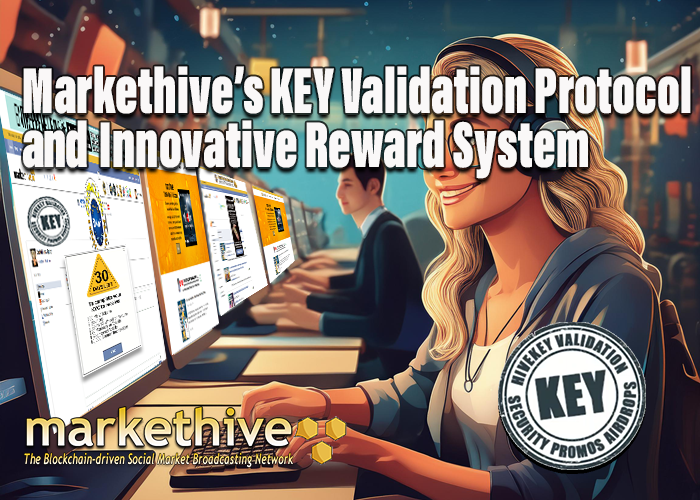
On the Markethive platform, users can opt to maintain their anonymity by using a pseudonym and avatar. However, the platform's Hivekey Validation verifies their identity behind the scenes. A key badge on their profile publicly indicates their KEY-verified status, so members will know they have completed the Hivekey Validation protocol and are genuine. 

By incorporating a video recording and upload feature in the Markethive vault, enabling 2FA, and using Social Network OAUTH during initial registration on the Markethive platform, we help ensure authentic individuals. This multi-layered verification process ensures genuine individuals interact on the platform rather than fake or fraudulent accounts.  

The KEY Validation Center 

The Markethive ecosystem for entrepreneurs is fueled by its crypto, Hivecoin (HVC). Whether you're new to the crypto industry or a seasoned crypto enthusiast, you have a variety of avenues to explore when looking to acquire HVC tokens. 

Markethive has implemented a unique, tiered qualification system that allows members to choose from the various eligibility levels by purchasing a qualification package. This initial purchase serves as a gateway into the HVC ecosystem. Depending on your chosen package, you unlock multiple benefits, including airdrops and bonuses that grant additional HVC tokens. The more you invest in your qualification, the more benefits and tokens you receive, creating a system that rewards long-term engagement and commitment.
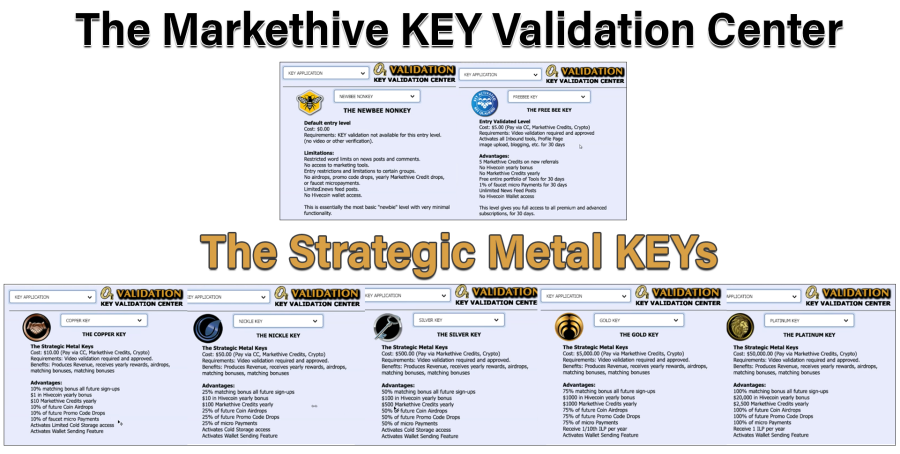

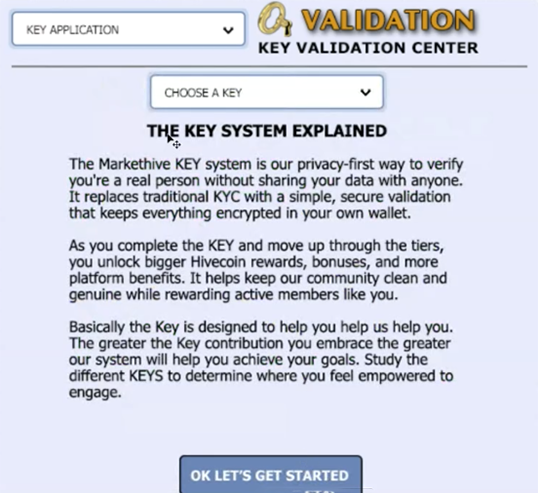
The image above and the following details an updated summary of the 7 KEY levels, which may be further refined and adjusted.

The KEY Qualification Levels

Beyond the entry-level options such as “NonKee” and "Freebee," Markethive provides five strategic metal KEYs. Once approved, each paid level confirms your account and grants you access to various rewards and advantages. Importantly, your selected KEY level activates the micropayments system and determines the value of the rewards you receive.

The value you receive from the KEY Validation process at all levels far outweighs the cost. It is an excellent way to kick-start your entrepreneurial journey with Markethive and acquire Hivecoin and ILPs. The two top levels essentially make you a shareholder, with a significant portion of Markethive’s net revenue paid monthly into your wallet. 

Markethive has shifted from distributing Markethive crypto token airdrops to offering $20 in Markethive Credits (MHC) to all new members, with each MHC worth $1. This reward is available to everyone, regardless of KEY validation status. The update provides a useful benefit, as these credits can be used directly for the KEY Validation process.

NEWBEE NONKEY: Default Entry Level
Cost: $0.00 
Requirements: KEY validation not available for this entry level. (No video or other verification)

Limitations:
– Restricted word limits on news posts and comments.
– No access to marketing tools.
– Entry restrictions and limitations to certain groups.
– No airdrops, Promo Code drops, yearly Markethive Credit drops, or faucet micropayments.
– Limited news feed posts
– No Hivecoin wallet access. 

This is essentially the most basic newbie level with very minimal functionality.

FREEBEE: Entry Validated Level
Cost: $5.00 yearly – (Pay via CC, Markethive Credits, Crypto)
Requirements: Video validation required and approved. 
Activates all inbound marketing tools, advertising tools, profile page image upload, blogging, etc., for 30 days. 

Advantages:
– 5 Markethive Credits for new referrals.
– Free full access to all tools for 30 days.
– 1% of faucet micropayments for 30 days.
– Unlimited new feed posts.
– No yearly Hivecoin bonus.
– No yearly Markethive Credits.
– No access to Hivecoin wallet.

The FREEBEE level offers a comprehensive 30-day trial of all Markethive premium and advanced subscriptions. This trial helps you explore every feature, making it easier to decide which subscriptions best support your marketing and business goals.

A significant benefit of this level is that, once successful KEY validation is completed, your account remains permanently verified, even if your level changes later. Plus, the validation process is easy to access; you can use part of the Markethive Credits given at signup toward the cost, removing the need for traditional credit cards or cryptocurrency.

COPPER KEY: A Strategic Metal KEY
Cost: $10.00 Yearly – (Pay via CC, Markethive Credits, Crypto)
Requirements: Video validation required and approved. 
Benefits: Produces revenue, receives yearly rewards, airdrops, and matching bonuses.  

Advantages:
– 10% matching bonus on all future sign-ups
– $1 yearly Hivecoin bonus
– $10 yearly Markethive Credits
– 10% of future *Coin Airdrops
– 10% of future *Promo Code Drops
– 10% of faucet Micropayments
– Access to Limited Cold Storage activated
– Wallet sending feature activated
 
*Future Coin and Promo Code Airdrops are Markethive’s promotional campaigns that are randomly held throughout the year. These incentive-driven events reward active community members in the ecosystem, offering opportunities to receive Hivecoin or exclusive promotional codes. While all strategic metal keys qualify for these drops, the specific percentage of the total airdrop value a member receives depends on their validated subscription tier, ranging from 10% for Copper Key holders up to 100% for Platinum Key members.

NICKEL KEY: A Strategic Metal KEY
Cost: $50 Yearly – (Pay via CC, Markethive Credits, Crypto)
Requirements: Video validation required and approved. 
Benefits: Produces revenue, receives yearly rewards, airdrops, and matching bonuses.  

Advantages:
– 25% matching bonus for all future sign-ups
– $10 in Hivecoin yearly bonus
*$100 Markethive Credits yearly
– 25% of future Coin Airdrops
– 25% of future Promo Code Drops
– 25% of Micropayments
– Activates Cold Storage access
– Activates *Wallet Sending Feature

At the Nickel Key level, the *$100 in annual Markethive Credits you receive fully covers the cost of renewing your KEY subscription for the next year. Additionally, the transaction capacity for Hivecoin in your *Wallet increases at this level and with subsequent levels.

SILVER KEY: A Strategic Metal KEY
Cost: $500 Yearly – (Pay via Markethive Credits, Crypto)
Requirements: Video validation required and approved. 
Benefits: Produces revenue, receives yearly rewards, airdrops, and matching bonuses.  

Advantages:
– 50% matching bonus for all future sign-ups
– $100 in Hivecoin yearly bonus
– $500 Markethive Credits yearly
– 50% of future Coin Airdrops
– 50% of future Promo Code Drops
– 50% of micro Payments
– Activates Cold Storage access
– Activates Wallet Sending Feature 

GOLD KEY: A Strategic Metal KEY
Cost: $5,000 – (Pay via Markethive Credits, Crypto)
Requirements: Video validation required and approved. 
Benefits: Produces revenue, receives yearly rewards, airdrops, and matching bonuses. 

Advantages:
– 75% matching bonus for all future sign-ups
– $1000 in Hivecoin yearly bonus
– $1000 Markethive Credits yearly
– 75% of future Coin Airdrops
– 75% of future Promo Code Drops
– 75% of Micropayments
– Receive 1/10th ILP per year 
– Activates Cold Storage access
– Activates Wallet Sending Feature 

PLATINUM KEY: A Strategic Metal KEY
Cost: $50,000 – (Pay via Markethive Credits, Crypto)
Requirements: Video validation required and approved. 
Benefits: Produces revenue, receives yearly rewards, airdrops, and matching bonuses. 

Advantages:
– 100% matching bonus for all future sign-ups
– $20,000 in Hivecoin yearly bonus
– $2,500 Markethive Credits yearly
– 100% of future Coin Airdrops
– 100% of future Promo Code Drops
– 100% of Micropayments
– Receive 1 ILP per year 
– Activates Cold Storage access
– Activates Wallet Sending Feature

Achieving a higher qualification status provides a greater return on your investment. Additionally, it can lower costs related to your Markethive product and service subscriptions, thereby significantly increasing your reach. The annual KEY protocol is the process for verifying member status and acquiring Hivecoin. All KEY levels function as subscriptions; however, you will be notified at the end of the year. You can then cancel or adjust your KEY level. Ultimately, you are free to select the KEY level for your ongoing qualifications.

The Promo Code Reward System

An added bonus is the Promo Code reward system, unique to Markethive. The KEY login process serves as a gatekeeper, allowing everyone to enter Markethive. However, to unlock the full potential of Promo Code rewards, users must complete the KEY Validation process to confirm their authenticity as community members.

Upon joining Markethive via a referral link with a Promo Code, new members receive a complimentary package of exclusive benefits and perks. This welcome bundle may include complimentary Wheel of Fortune spins, free marketing and communication tools such as Boost, Push, or Lift, a 30-day trial of the Premium Upgrade, banner impressions, Markethive Token Airdrops (MHV), or a redeemable value in Markethive Credits (MHC). 

After registering with the provided Promo Code, users will be prompted to complete the KEY Validation process at their first Markethive login to unlock the benefits associated with the Promo Code. New users have a 30-day window to complete the KEY validation process and will receive reminders at each login. 

Completing this protocol unlocks a range of exclusive products and services, enabling new members to experience the platform's diverse offerings. This innovative approach benefits both the individual and the broader Markethive community. Certain Promo Code offers include referral incentives, where the referrer can earn matching bonuses. 

After approval, a pop-up will show you the benefits of the Promo Code. It will also indicate your entry level and outline the bonuses available for micropayments and airdrops.

Conclusion

In summary, Markethive is about building a robust, genuine environment that rewards the community for active participation. By completing the KEY Validation process, members are verified as real individuals, ensuring a secure environment for communication, social interactions, and business interactions within the Markethive platform.

The purpose is to create an active, dynamic, and secure “hive of people” with an entrepreneurial spirit, both in the entrepreneur set and its subsets, fostering a culture of positivity rather than negativity and dishonesty. This community is characterized by love and stands in stark contrast to the current fear-driven society.

It is not the “cancel culture” prevalent on legacy social media, but a meritocratic, autonomous culture with a sense of humor where everyone enjoys what they do, far removed from the oppressive tyranny that has engulfed the world. We are a community dedicated to seeking and proclaiming the truth, guided by a divine vision that empowers us to build a strong economic framework. This framework enables us to overcome the forces of elitism and oppression.

Markethive has achieved a unique balance between confidentiality and openness. Our secure vault protects your verified identity and offers an avatar feature to help you maintain your anonymity on public news feeds. Meanwhile, our blockchain-based, cryptocurrency-powered ecosystem ensures a transparent and trustworthy economic environment. 


Editor in Chief Markethive: Deb Williams. (Australia) I thrive on progress and champion freedom of speech.  I embrace "Change" with a passion, and my purpose in life is to enlighten people to accept and move forward with enthusiasm. Find me at my Markethive Profile Page | My Twitter Account | and my LinkedIn Profile.


Markethive Activity Report 5052024

Markethive Activity Report 5/05/2024

In this weekly report, we delve into the blockchain activity of Hivecoin within the Solana blockchain and have an insight into how Hivecoin's transactional activities have been for the week. As members invested in the growth and performance of Hivecoin, understanding transaction trends provides valuable insights into user engagement, network usage, and overall ecosystem health. 

At the heart of our analysis lies the recognition of transactions as the lifeblood of any blockchain network. Each transaction represents a node of activity, a testament to user engagement, and a contributor to the overall health of Hivecoin within the Solana ecosystem. By dissecting transaction trends, we unravel a tapestry of behaviors, patterns, and preferences that shape the trajectory of our digital asset.

Our primary objective in dissecting these transactional patterns is twofold: first, to glean actionable insights that empower strategic decision-making, and second, to optimize Hivecoin's strategic positioning within the vibrant landscape of decentralized finance (DeFi). Armed with a deeper understanding of user behavior and network dynamics, we can navigate the ever-evolving DeFi terrain with agility and foresight, ensuring Hivecoin remains at the forefront of innovation and adoption.

Hivecoin Blockchain Activity

  • The Hivecoin faucet offers a daily claim of Hivecoin, making it accessible to all users within the Markethive community and beyond.
  • The total faucet claims of Hivecoin as of this writing stand at 3,664, indicating a growing community of users actively engaging with the token.
  • Daily transaction counts on the Solana blockchain were recorded for the week spanning from April 28 to May 4th, providing a granular view of transaction activity over the designated period.
  • The total number of transactions processed amounted to 144, reflecting sustained engagement with the Hivecoin network. Analyzing daily transaction volume revealed fluctuations, with peak activity observed on April 28th and May 3rd, recording 31 and 30 transactions each, and relatively lower activity on April 30th, with 14 transactions. 
  • Hivecoin's blockchain activity reflects a vibrant and engaged community, and by actively sending coins back and forth to each other, members can further stimulate the blockchain activity and strengthen the token's presence within the Solana ecosystem.

 Community Engagement Report

  • This week, the community has shown remarkable dedication to enhancing the presence of Markethive on various platforms. 
  • A concerted effort was made to increase activity on the Markethive Bitcointalk page, aiming to foster vibrant discussions and interactions.
  • The community also turned its attention to the Markethive Trustpilot page. Numerous community members submitted reviews, sharing their personal experiences and feedback about Markethive's services.
  • These initiatives are part of a broader strategy to elevate Markethive's visibility and user engagement within the digital space.
  • The continuous active participation is expected to not only boost Markethive's online presence but also to attract new users and stakeholders to the platform.

We encourage the frequent exchange of Hivecoin within and outside the Markethive community because it serves a tremendous purpose. Firstly, it cultivates a vibrant and active blockchain environment, enhancing its resilience and dynamism. Secondly, it showcases the tangible utility and demand for the token among community members. 

Such heightened engagement not only amplifies the token's intrinsic value but also plays a pivotal role in advancing Markethive's mission. By bolstering blockchain activity, it bolsters Markethive's endeavors to secure listings for Hivecoin on prominent exchanges. This, in turn, extends the reach and functionality of Hivecoin beyond the confines of the Markethive platform.

In essence, this cycle of active participation fuels a positive feedback loop, propelling both the token and the platform towards greater recognition and utility within the broader cryptocurrency landscape. 

Join the Markethive Community Group and be part of those who shape the future of Hivecoin within the Markethive ecosystem!

God Bless Markethive!


About: Prince Ibenne. (Nigeria) Prince is passionate about helping people understand the crypto-verse through his easily digestible articles. He is an enthusiastic supporter of blockchain technology and cryptocurrency. Find me at my Markethive Profile Page | My Twitter Account | and my LinkedIn Profile.


Supervising Crypto In Europe

Supervising Crypto In Europe


End of June 2022, Cointelegraph.com published an article on the new agreement reached by the European Council to form an Anti-Money Laundering (AML) body that will have the authority to supervise certain crypto-asset services providers (CASPs).

But let's start with a summary first. The first flurry of regulation of crypto-assets appeared in Europe even before the pandemic in December 2019. Debugging took place throughout the first half of the following year, and in September 2020, the European Commission adopted it under the legislative designation draft regulation on markets in crypto-assets (MiCA for short).

A definite topic in the world of finance is currently the government regulation of cryptocurrencies, which is taking place across the globe. The approach in different states is diversified –  some states give cryptocurrencies a clear green light, others treat them more cautiously and introduce many regulatory regulations, and finally, there are states that have said a clear “no” to cryptocurrencies and banned them on their territory. 

The market segment with cryptocurrencies, estimated at $2.1 billion, is still subject to inconsistent regulation, which prevents the creation of legislative regulations that should prevent money laundering while protecting investors and creditors. 

However, increasing regulatory pressure is preventing crypto companies from innovating their products. For example, the cryptocurrency exchange Coinbase global warned that over-regulation would hamper innovation.

Image Source: Cointelegraph

Wild West Of Crypto Is Nigh

We are putting an end to the wild west of unregulated crypto, closing major loopholes in the European anti-money laundering rules,” said European Parliament member Ernest Urtasun.

The European Council said it had agreed on a partial position of a proposal to launch a dedicated Anti-Money Laundering Authority or AMLA. According to the regulatory body, the AML body will have the authority to supervise “high-risk and cross-border financial entities,” including crypto firms — “if they are considered risky.”

First proposed in July 2021, the AMLA should be operational in 2024 and “start the work of direct supervision slightly later,” according to the European Commission. 

It is evident that the taming of cryptocurrencies in the EU is imminent. By regulators who don't understand it much.

Europen Central Bank, Frankfurt,  Germany

The European Central Bank (ECB) is calling for decisive regulation of cryptocurrencies. People are speculating on life savings because of them, which is not to the liking of the head of the bank, Christine Lagarde. Its approach does not seem to many analysts, according to which most regulators propose measures that are not really applicable in practice.

The first application of the new regulatory conditions around cryptocurrencies could come in the next few months. The European Commission has already presented such measures, and the European Parliament should finalize them soon.

This is MiCA regulation and, therefore, regulation aimed explicitly at crypto-assets. But analysts recall that most regulators do not understand cryptocurrencies at all and are therefore rather skeptical about the proposals.

In addition to Christine Lagarde, other ECB officials have previously expressed concerns about cryptocurrencies. One of them is executive board member Fabio Panetta, who said in April that crypto assets are creating a new wild west and compared them to the subprime mortgage crisis of 2008. 

On the other hand, European monetary policymakers have confidence in their new digital euro project, which could take place as early as the next four years.

"Basically, almost all traditional institutions view cryptocurrencies as something dangerous and potentially exploitable or as a tool for money laundering and unfair activities. In doing so, these fears are completely odd and senseless. Regulators mainly want to achieve the greatest possible monitoring of financial movements, " said Czech analyst Martin Kysela.

Cryptocurrencies And Crime

The suppression of illegal cryptocurrency trading is taking place on more fronts than it might seem at first glance. The fight against money laundering has already moved to Europe. 

German authorities announced a raid on the world's largest darknet market, in which they seized bitcoins worth 25 million euros. This raid was carried out in cooperation with the German cybercrime centre and the federal criminal police office (BKA). For what reason did the raid occur, and what was its result?

In a raid on the world's largest darknet network called Hydra market, 543 bitcoins were seized. This illegal network has reportedly been operating since 2015 and has read an incredible 17 million customers. 

In the Hydra market, more than 19 000 sellers were registered who focused on the sale of illegal narcotics. According to the press release, other items were seized during the raid, which brought profits to the sellers.


Nanny Mentality Undermines Freedom Of Choice

On Dutch television, the president of the European Central Bank (ECB), Christine Lagarde, said this in May.

Cryptocurrencies are based on nothing and should be regulated so that people avoid speculating with their life savings.” 

She is afraid that people who do not understand the risk can lose everything and be very disappointed. Therefore, she believes that cryptocurrencies should be regulated.

First of all – if Ch. Lagarde and others believe that cryptocurrencies are worthless, they would not be so afraid of them, which leads them to the regulations to which the cryptocurrency market is already subject today. 

Many people see cryptocurrencies as a sign of freedom (and it doesn't matter what anyone thinks about it), and the EU obviously doesn't like that. It seems the representatives of the EU think people are unruly and should be regulated. 🙂

In the black scenario, some crypto specialists think that regulation could significantly damage crypto services in the EU. It may trample on user privacy and expose users to the risk of personal information being hacked. As a result, it may have a minimal impact on the fight against money laundering, which the EU seeks with this law.

Cryptocurrency exchange Coinbase stressed that it is cash that continues to be a popular means of money laundering. Blockchain technology, unlike cash, has allowed authorities to track suspicious transactions using advanced analytical tools.

Cryptocurrencies are highly speculative investments (and therefore attractive). The principle of any highly speculative investment is that money moves from those who lose a lot of money on the speculation to those who make a lot of money on it. It is difficult to regulate anything on this.

It’s All About Control

Crypto is unwanted by the top politicians because it gives the owner immense freedom to dispose of their finances in their own way and store them wherever they want – without the need for control by any regulator.

By the way, this control requirement is fully in line with the current direction of EU policy. Therefore, it is undesirable for someone to have access to finances that can not be regulated. The regulation or abolition of bitcoin and other cryptocurrencies would bring us a step nearer to totality.


Source:

cointelegraph.com

Idnes.cz

Cryptosvet.cz

Forbes.cz


The Z Generation And Cryptocurrency

The Z Generation And Cryptocurrency


In recent years, we have witnessed the emergence of a new generation, who are often referred to as the “Z Generation.” A generation that has only ever known a world with the Internet. They have grown up in a time of rapid technological development and have been raised with ever-increasing political, social, and economic uncertainty. 


They are connected, globally-minded, and innovative; they are a product of their time in many ways. Gen Z is very familiar with technology and has always had access to it, and they do not need to be taught or encouraged to use it. They live their lives through their devices and social media, and many have turned to cryptocurrencies as an alternative investment.

Money And Excitement From The Game. 

The young are not discouraged by the endless crashes from cryptocurrencies, and they see it as a means to accumulate wealth and an investment opportunity. 


As 20-year-old Paxton See Tow told the BBC, "All my friends were talking about cryptocurrencies, so one day I decided I could get involved too and see if I could make a living." 

All he needed was a phone, and he was only a few clicks away from thousands of dollars in cryptocurrency purchases.


Who Are Gen Z?

Generation Z is a group of people born around the mid-1990s until about 2010. So it grew up in an interconnected world at a time when the Internet was practically everywhere. They are used to playing online games and meeting friends virtually, without physical contact.

This new generation was born into a relatively peaceful time. However, a peaceful childhood is undoubtedly compensated for by the events that take place during their adolescence. Recent developments in the world are proof of this. 

The Black Lives Matter movement in America, the riots in Hong Kong, and the Fridays for Future Movement have spread around the world. All these movements were founded or strongly supported by representatives of the Z generation.

The Economist has described Generation Z as a more educated, well-behaved, stressed, and depressed generation in comparison to previous generations.

From Wikipedia:

Other proposed names for the generation include iGeneration, Homeland Generation, Net Gen, Digital Natives, Neo-Digital Natives, Pluralist Generation, Internet Generation, Centennials, and Post-Millennials.


They Are Among The Technologies At Home

The development of technology is undoubtedly an important factor that contributed to the definition of Generation Z. 

In his article Digital Natives, Digital Immigrants, Marc Prensky describes Generation Z as a digital native, and they are surrounded by technology from birth. According to Prensky (2001), the younger generation "thinks and processes information significantly differently than its predecessors."

The possibility of quick profits has always attracted young people to invest in risky assets. For Generation Z, it is the significant price fluctuations – and the decentralized nature – of digital assets that are pulling. 

Whether they are cryptocurrencies or so-called unmistakable tokens (NFT), however, no one regulates the sector, which means minimal investor protection.


The trend for young people to trade in cryptocurrencies and NFTs has intensified during the pandemic. 

"The market has gone through extreme price fluctuations. When you have such fluctuations, you have an opportunity in the market," says Lily Fang, a professor of finance at INSEAD Business School. 

"Young people stayed at home, and it became almost a game. All these factors created the perfect conditions for that."


The Thrill Of it All

But in addition to financial losses, addiction is also a great danger. Resh Chandran, a financial educator, said, “The cryptocurrency market never sleeps, so people really swallow it up.”

Andy Leach from an addiction clinic in Singapore says he has experienced an increase in addictions to the thrill of trading crypto and NFTs and confirms Chandran’s sentiments, stating, 

“You can watch the bitcoin rise and fall, the whole process, the roller coaster ride, the highs and lows – all on your phone, 24 hours a day, seven days a week.” 


Making Money As A Game

But even the stories of people who lost a lot of money on cryptocurrencies do not seem to discourage young traders. Many of them have encountered digital assets for the first time through games that allow them to obtain NFTs or cryptocurrencies and use them within the game itself or exchange them for cash.

"Every child wants to make money playing games," says a 23-year-old Malaysian businessman who is nicknamed YellowPanther. "This is the dream of my generation."

“In the Czech Republic, the number of wallets with cryptocurrencies is estimated at half a million,” says Binance marketing manager Maya Bersheva.

On the opposite side of the globe, research has shown that one in five Australians believes that crypto is the key to homeownership as confidence in traditional savings dwindles. 

A survey conducted by the Kraken Cryptocurrency Exchange found that a growing number of young Australians are depressed by traditional investment opportunities. Almost a quarter of respondents expressed concern that the value of money in traditional cash savings is declining.

A similar trend is confirmed by other research showing a change from traditional attitudes towards investment and property. More than a third of millennials view crypto assets as an increasingly valid alternative to an elusive investment property, a new survey finds.

Commissioned by cryptocurrency exchange Kraken, it found that around four million Aussies say they are likely to purchase digital currencies in the next 12 months.

The survey, which was conducted by global researcher YouGov, found 21% of Australians are readying to purchase digital tokens if they hadn’t already, including 34% of millennials and 32% of Gen Z.

According to the survey, young Russians consider cryptocurrencies a safe investment. Due to Western sanctions, which increase the pressure on Russia's economy, young Russians consider cryptocurrencies to be a reliable and profitable investment. According to a recent study on the existence of BTC, two-thirds of Russian citizens know.


New Research Shows That 40% Of Young People Want To Use Cryptocurrencies For Payments

Cryptocurrencies are rapidly gaining in attractiveness among younger groups, with 40% of consumers aged 18-35 expressing their intention to use cryptocurrencies such as bitcoin, ethereum, and stablecoins to pay for goods or services within the next 12 months.

The report, entitled "Cryptocurrency Demystification: Shedding Light on the Acceptance of Digital Currencies for Payments in 2022," was presented by global payment provider Checkout.com at the Bitcoin 2022 conference in Miami on April 6. It revealed an increasingly positive trend in accepting cryptocurrencies for online payments.

Although digital currency often pretends to be an investment for young people, they often pay the most for its volatility. The "computer generation" perceives crypto as a game that can be easily and well earned.


Thanks for reading

                                   Margaret


Source:

https://zpravy.aktualne.cz

https://kryptomagazin.cz

https://medium.com


THE RABBIT HOLE OF MULTI-LEVEL MARKETING MLM

THE RABBIT HOLE OF MULTI-LEVEL MARKETING (MLM)

The Multi-Level Marketing Industry has been around for decades starting out with home parties or Party Plan and predominantly seen by women as a way to supplement the family income. MLM companies never advertised on mainstream media, so relied on word of mouth and solicited recruitment of anyone inexperienced or otherwise, and that was all well and good until the hype of fulfilling dreams of getting rich beyond your wildest dreams, firing your boss, becoming your own boss all because of the unsustainable and complicated compensation plans created by the company to entice anyone that would listen.  

Over time the MLM industry has evolved online and this is when scams escalated and the promise of untold wealth for doing nothing really became a mindset.  Some companies have products albeit a few making outrageous claims about the benefits, but many don't have a product or service or at the very least they portray a facade of digital products that could normally be accessed online for free. The latter has been dubbed a money game showcasing their gimmicky comp plans since the internet era. Fundamentally, if an MLM company pushes recruiting and is only interested in building a team to fill up a matrix in the compensation plan, not focusing on acquiring customers to buy their product, this is considered a pyramid scheme and very much a red flag.  

There are programs that have failed, only to pop up later with a new name but similar model sucking in unsuspecting and usually desperate people looking to make an income online, or even worse believe the promise of getting rich quick. There are a number of individuals that keep launching new companies, all with matrix or binary comp plans then eventually closing them, then move on to the next, then another, and people losing money hand over fist with no recourse.


Common Sense. Do The Math

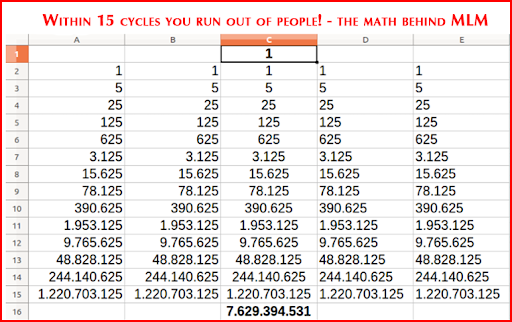
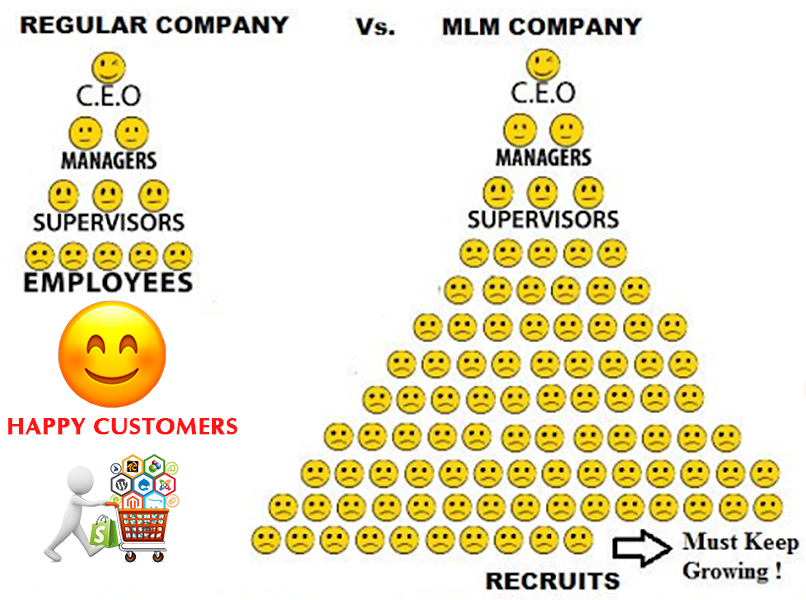
MLMs work by geometric expansion, where you get ten to sponsor ten, to sponsor ten, and so on. This is usually shown as an expanding matrix (looks very much like a "pyramid"!) with corresponding kick-backs at various levels.

The problem here is one of common sense. At a mere three levels deep this would be 1,000 people. At six levels deep, that would be 1 million people believing and expecting to make the amount of money promised to fulfill their dreams of becoming a millionaire. This, of course, must go on ad infinitum. This is proven to be unsustainable, there just wouldn’t be enough people in the world, let alone interested prospects, not to mention the attrition or churn rate of recruits. 

I have spoken to individuals who know its limitations and flaws and they just say, “That’s ok, at least I can make some money while it lasts.” What about the poor people that come in after you? 

The ethical question is, Are MLMs a morally acceptable way to make money? 


There are a few MLM companies that have been around for years that are legitimate as they concentrate on selling the products, some have even done away with their suspect compensation plan to stay in good stead with the Federal Trades Commission. (FTC)  Illegal pyramid schemes do have a product, but critics say that many MLMs have a business model that focuses on recruiting “downline” and getting new distributors to buy the product, rather than on actual sales to consumers, making them akin to pyramid schemes.

When you take a look at the FTC, and what they have to say about MLM companies, you need to offer retail products in order to stay in compliance with the law. This can be confusing for some however what it means is a company must have retail products that can be purchased by customers only without them having to become a distributor and buy into the opportunity offered through the comp plan to get those products.


Multi-Level Marketing Is The “Brand”

Robert L. FitzPatrick is an expert in examining and revealing deception and fraud in Ponzi schemes, pyramid schemes, and bogus home-based businesses opined,

“MLMs do not have brands in the same way that conventional companies do. Some MLMs have almost no "customers" at all other than their own “distributors” and most of them last less than a year. Arguably, MLM can’t be understood by business analysts because it more closely resembles a cultic religion than a business.

MLM’s “brand” is not based on products or on company culture, customer loyalty, or on new technology or social or political values. The brands of all MLM companies are one and the same, "multi-level marketing" itself, the contradictory business model, involving recruiting your own competitors and “being your own customer.” Each and all require “endless chain” recruiting and they always produce the same outcome: the majority of all “commissions” wind up in the hands of the top 1% of recruiters, kind of like a pyramid scheme always does.”

Polarization Runs Deep

While this is the most difficult point to make, it is perhaps the most important. Anyone who has any experience with an MLM has strong feelings, either for or against, and this is the problem. Polarization runs deep. 

There are a host of issues brought forth regarding multi-level marketing companies, often from former distributors and the disgruntled community is growing. If you search YouTube, you can find countless videos outlining the numerous problems with various MLM companies.


How MLMs Defend Themselves

There have been many arguments raised by MLMers. 

“How can it be a pyramid scheme if it’s legal?” 
Through some crafty loopholes. The fact that there is an actual product to sell allows them to operate and give the appearance of legitimacy. If you need to fill your matrix up to be eligible for commissions, it’s a pyramid scheme. 

“You just haven’t found a good MLM yet.” 
Wrong. A good MLM is an oxymoron. Multi-level Marketing is the brand. No matter what products they have, if the distributors are forced to recruit, then most are doomed to failure. The biggest problem with MLM’s is that most distributors don’t make a profit. In fact, a majority end up losing money. According to the FTC, an astounding 99% of recruited sellers lose money. From the FTC report: “MLM as a business model is the epitome of an “unfair or deceptive acts or practice”.

“But how is this any different from any other major corporation where the CEO makes the most money?” 
Because the people below the CEO at legit companies get paid salaries and have actual benefits. They don’t depend on endless chains of recruiting new members and asking for money upfront.

Comp Plans Detailed

Jeff Babener, Babener & Associates/MLMLegal.com published a guide explaining the major types of plans. The two outlined below became popular since the advent of computer technology.  

The Matrix Plan

This plan looks like a grid in which a distributor is limited to a certain number of recruits at each level. For example, in a 3-by-5 matrix, each level down to five can have only three downline distributors.

This type of plan is sometimes considered to be more gimmicky than others. Why? Because due to the width limitations, new recruits may find themselves placed underneath upline distributors who did not directly recruit them. In a three-wide matrix, for instance, the fourth distributor you personally sponsor would be placed under one of the first three distributors you personally sponsored (your first-level distributors).

Matrix plans have been subjected to attacks by regulatory agencies because they sometimes look like "a game." By and large, they have not had a successful record in the industry, and they foster nonproducers, which makes the upline distributors resentful. Nevertheless, several major companies operate matrix plans. 


Binary Plan

The binary plan is the newest on the scene. In a binary plan, a distributor is allowed to occupy one or more "business centers," each limited to two downline legs. Compensation is paid on group volume of the downline legs rather than a percentage of sales of multiple levels of distributors. In other words, payment is volume-driven rather than level driven. Sales volume must be balanced in the two legs to be eligible for commissions, which are paid at designated points when target levels of group sales are achieved. 

The distributor may occupy multiple positions and may re-enter or loop below the other two leg matrices in which he or she has been active. There is no depth limit on payment but each matrix has a finite amount that can be paid out, thus necessitating involvement in multiple two-leg matrices. 

The binary is the most controversial of plans. The binary had its unfortunate origins in the early 1990s in fraudulent gold coin programs, and its use later for other questionable products did not help. Those subsequent products were generally high-ticket one-time purchases such as consumer service or travel memberships, travel certificates, or overpriced prepaid phone cards. By the end of the 1990s, and after many legal challenges, the binary was not in great favor, and only companies like USANA, that had applied the concept to consumables, seemed to be around.

Critics charged that the implementation of binary plans brought on legal and business problems. Companies and distributors tended to promote the plan rather than the product, creating accusations of a "money game." Often plans had a one-time sale requirement which created a something-for-nothing atmosphere and appearance of payment for headhunting recruitment. 

The multiple business center approach was often presented as a "purchase of a business center," an "investment," or a "front-load" of product. The ability to stack personal business centers also created the possibility of front-loading. The required balancing of sales volume between legs meant that hard work might yield no payoff and income would be forfeited because personal production did not count if balanced sales volume did not occur. 

Finally, the multiple re-entry or looping created a "game-like" atmosphere in which an individual could end up in the downline of someone he or she had sponsored. For the distributor looking long term at a distributorship that might be sold, this "looping" also made it virtually impossible to place a value on a distributorship because no continuous downline genealogy could exist.


The Legitimacy Of Multi-Level Marketing

An issue in determining the legitimacy of a multilevel marketing company is whether it sells its products primarily to customers or to its distributors who must recruit new members to buy their products. In other words, does it emphasize getting products or services into the hands of consumers, or does it emphasize making money by finding new recruits? If it falls into the latter category, run away, fast. In the end, it’s the product, not the compensation plan that drives success.

Most people that are lured into these companies have little money to invest and want to believe the hype about utopian promises, get rich quick schemes, and how they can achieve great success. How they can fire their boss and be their own boss. Essentially, you are not your own boss. You have no control over the company, its products, people you recruit, or comp plan. 

Multi-level marketing companies are not new. However, with the rise of social media, more people are becoming fed up with their tactics. In fact, there is an anti-MLM subreddit devoted to calling out MLM practices and product quality. If you are considering buying a product from or signing up with an MLM opportunity, do your research first. 


Legitimate Company Investments Out Of Reach For Most? Not Any More.

The idea of investing in a legitimate company at a grassroots or shareholder level was out of the question. Only capital investors or entrepreneurs with millions of dollars were invited or could get involved. Hence the saying the rich get richer and the poor get poorer”, until now.

Markethive has been created for the rank and file to achieve success on every level. Starting out with the ability to promote your business with all the inbound marketing tools including blogging platforms, email services, CMS, etc, which you would normally have to pay for is free to use at Markethive. Then there is the collaborative social media platform of like-minded individuals which of course is free. It’s free but you get paid to use it! 

Huh? How? Blockchain Technology and Markethive’s crypto ecosystem has made this a reality for everyone to attain sovereignty and the freedom to create an income. It’s also the answer to an inequitable marketing industry.

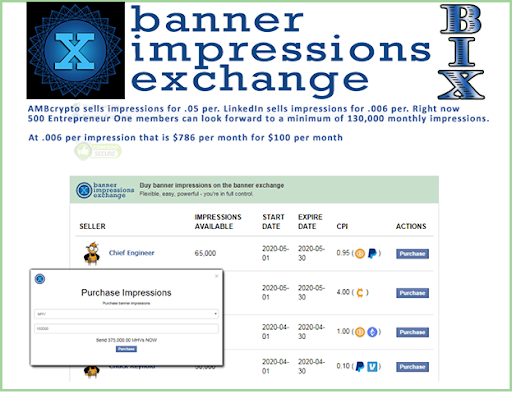
But the icing on the cake is the ability to become a shareholder in Markethive via the Entrepreneur One Loyalty Program for $100 per month. This involves not only your cumulative share of an ILP (Incentivized Loan Program) but a number of cottage businesses that are like your franchises where the earning potential on these genuine products is huge. 


The first one being launched at the end of this month is the Banner Impressions Exchange. (BIX) Markethive does all the work, drives the traffic and you sell your share of impressions for the price you set. You keep all the profits from the impressions you sell, for one small flat monthly fee of $100. Now that’s an offer never seen before and allows regular folks like you and me to realize financial success in a real company, not driven by greed or imperialistic status. 

Marketers and businesses pay 10 to 20 times more than $100 per month just for the inbound marketing tools mentioned above that you get for free in Markethive!  

Real Business. Real Services. Making Dreams a Reality

This is not MLM, this is a real business and social market platform with next-generation technology and provides services that are proven and products with substantiated and provable facts. These are products that are being used all over the internet for the purpose of creating exposure to all businesses and content. This medium is increasing exponentially as more companies choose to advertise online. It’s unfortunate that MLM victims are so accustomed to getting ripped off they find it difficult to determine a genuine company.

The Visionary and Founder of Markethive, Thomas Prendergast explains in this video the conditioned mindset of the many that keep them trapped in the merry go round of living week to week, paycheck to paycheck. He also elaborates on the BIX that will be open for all Entrepreneur One upgrades to trade,

What do the rich buy? A millionaire mindset vs the poverty mindset

Breaking News

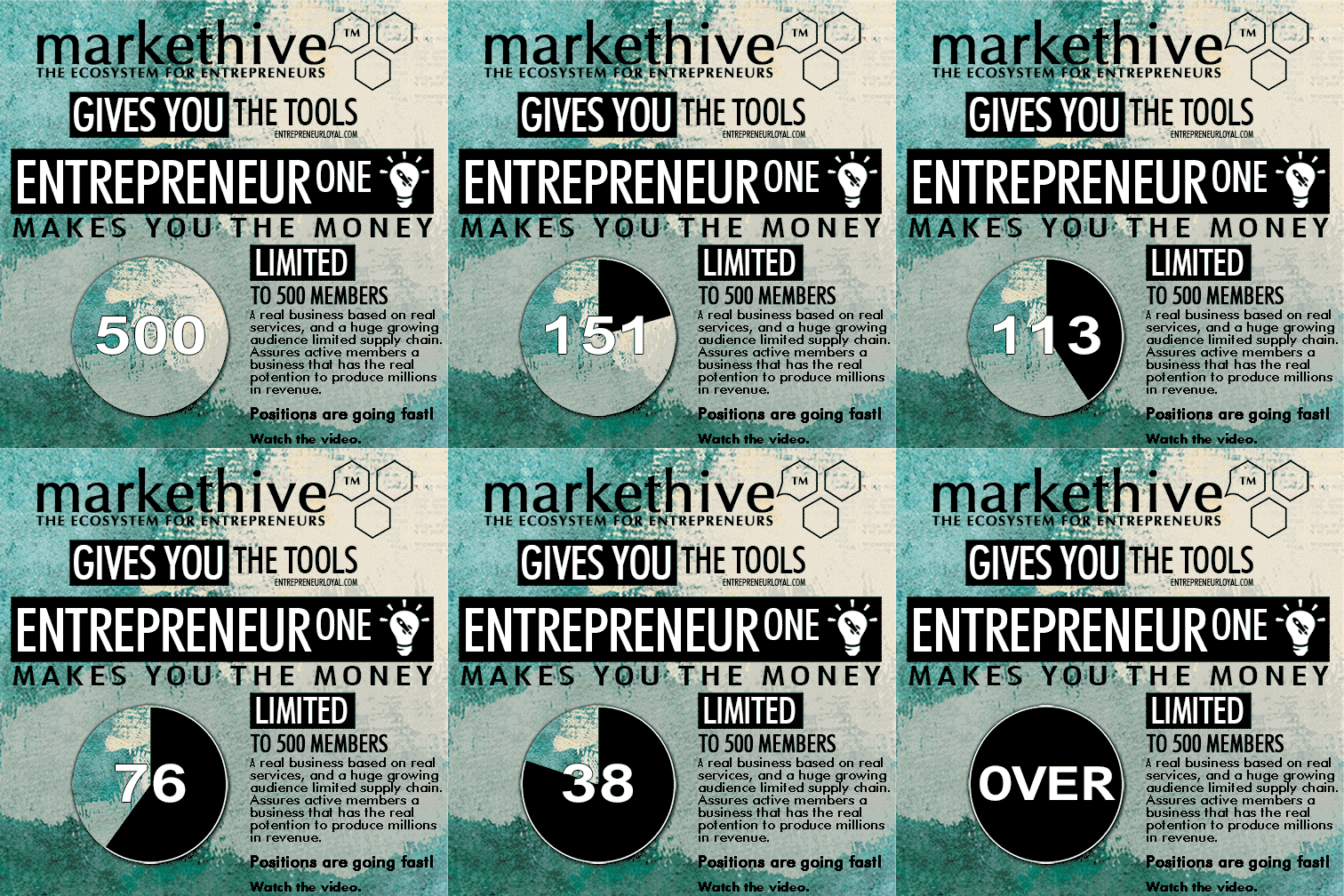
The Entrepreneur One Loyalty Program for $100 per month is limited to 500 with the rollout of the first of many franchises (BIX) expected to launch on May 1st, 2020. After that date, if there are any E1s left they will be available for the purchase of $1,500 per month. Until then, we are calling on people to beta test the exchange.

The Entrepreneur Two, Three, Four, etc, have been taken off the table to focus on the Apprentice and Journeyman subscriptions. More on that soon. 

If you’re still thinking about upgrading to E1 to take advantage of the money machines Markethive has in store for you as well as becoming a shareholder, you only have 8 days left at the time of writing this. Don’t be a “shoulda, woulda, coulda”, that can be a costly exercise. You really can be your own boss with the control required to succeed in Markethive making it your primary source of income.  

Click this link to upgrade before May 1st.   https://markethive.com/upgrademe


ecosystem for entrepreneurs


Deb Williams
A Crypto/Blockchain enthusiast and a strong advocate for technology, progress, and freedom of speech. I embrace "change" with a passion and my purpose in life is to help people understand, accept, and move forward with enthusiasm to achieve their goals. 

Cryptocurrency adoption is key to financial inclusion

Cryptocurrency adoption is key to financial inclusion "CoinDCX CEO"

Providing financial inclusion for all is Markethive’s main objective.

The answer is Markethive’s blockchain technologies, and integrated entrepreneurial ecosystem.


In a recent article for Nasdaq, Sumit Gupta, CEO of CoinDCX, one of India’s largest cryptocurrency exchanges, wrote about how cryptocurrencies could hold the keys to financial inclusion. In the article, Gupta cited the World Bank’s most recent Global Findex report which stated that as many as 1.7 billion people worldwide do not have access to formal financial services. However, Gupta noted that two-thirds of unbanked individuals have access to a mobile phone.

The CoinDCX CEO argued that in such a “highly globalized, technology-driven world,” one with 5.11 billion unique mobile phone users and 4.39 billion Internet users last year, “cryptocurrencies could be the answer to ensuring greater financial inclusion and opportunities for all.”

According to Gupta, the vast majority of the unbanked live in poverty-stricken areas with emerging economies. This dual-threat of poverty and economic hardship makes the barrier to entry for traditional financial services too high for low-income individuals and traveling to physical bank offices can prove “inconvenient and costly for those living in rural areas,” he said. Gupta added,


Gupta also spoke of how there are no costs for holding or managing cryptocurrencies which, unlike banks, don’t require a lengthy approval process to get hold of. Further, he claimed that adopting cryptocurrencies can be advantageous to countries where volatility and non-existent financial infrastructure is the norm. Venezuela is one such example, a country where Bitcoin and Dash usage has spiked in an attempt to combat the devaluation of the local fiat currency.

“For these Venezuelan citizens, cryptocurrencies are not just a means for protecting their wealth, but also an alternative medium for conducting everyday transactions.”

Sumit Gupta also said that an inclusive financial system could inadvertently boost socio-economic growth, lifting communities out of poverty. Additionally, he also said that if cryptocurrencies are to have the desired impact in bringing the unbanked into the financial ecosystem, promoting mainstream adoption and a coordinated approach between global regulators and policymakers will be key.

Gupta also spoke of how there are no costs for holding or managing cryptocurrencies which, unlike banks, don’t require a lengthy approval process to get hold of. Further, he claimed that adopting cryptocurrencies can be advantageous to countries where volatility and non-existent financial infrastructure is the norm. Venezuela is one such example, a country where Bitcoin and Dash usage has spiked in an attempt to combat the devaluation of the local fiat currency.

“For these Venezuelan citizens, cryptocurrencies are not just a means for protecting their wealth, but also an alternative medium for conducting everyday transactions.”

Sumit Gupta also said that an inclusive financial system could inadvertently boost socio-economic growth, lifting communities out of poverty. Additionally, he also said that if cryptocurrencies are to have the desired impact in bringing the unbanked into the financial ecosystem, promoting mainstream adoption and a coordinated approach between global regulators and policymakers will be key.

Sumit Gupta also said that an inclusive financial system could inadvertently boost socio-economic growth, lifting communities out of poverty. Additionally, he also said that if cryptocurrencies are to have the desired impact in bringing the unbanked into the financial ecosystem, promoting mainstream adoption and a coordinated approach between global regulators and policymakers will be key.

“Smart regulation is crucial to ensuring a secure and equitable system in which cryptocurrency holdings are protected, without hindering the potential of the technology.”

Markethive is leading this revolution and has the very real potential to be on par as the top utility coin with Bitcoin being the top FinTech coin.


Thomas Prendergast
Markethive

Content from AMBCrypto